
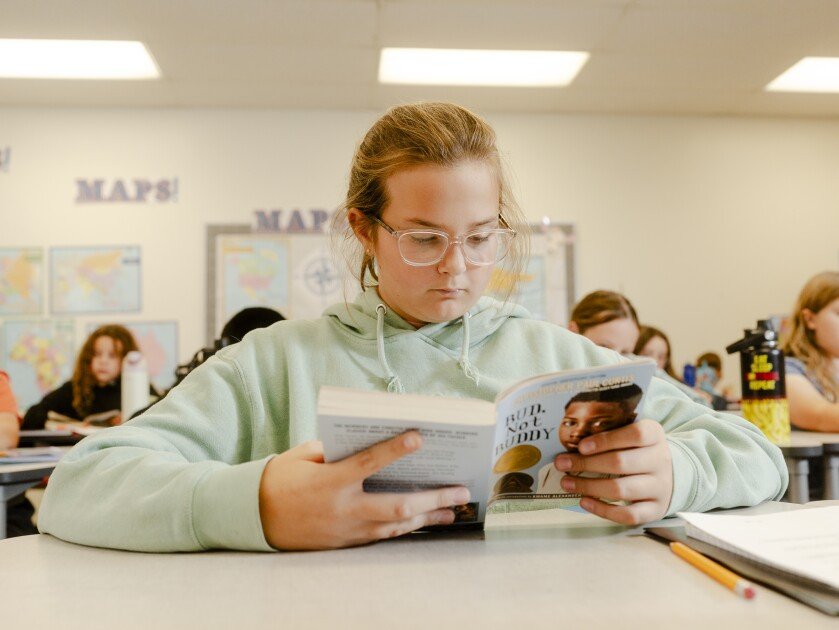
Some high school teachers and college professors have been ringing alarm bells about what they see as a troubling trend in America’s schools: Students aren’t reading whole books in class anymore, they say.
But new data from the RAND Corporation shows that the vast majority of secondary school teachers do report assigning full-length texts—though perhaps not as many as some educators and advocates would like.
“This data really provides some nuance,” said Ashley Woo, an associate policy researcher at RAND, and the author of the report.
Nine in 10 middle and high school teachers surveyed during the 2024-25 school year said they planned to assign at least one full book before the end of the academic year. Eighty-three percent of elementary school teachers said the same.
On average, secondary school teachers assigned four books total. But a substantial proportion of teachers lay at either extreme of the spread, with about a third only assigning 1-2 books for the year, and a quarter assigning five or more.
Advocates of book-heavy curricula say that reading these longer texts helps strengthen students’ attention spans and develop more sophisticated reading comprehension skills. Books can capture students’ interest and create communal classroom experiences in ways that short excerpts can’t, many teachers say.
Research is less definitive. While there’s ample evidence that demonstrates students who read more are better readers, there aren’t many studies that pinpoint exactly what a child’s reading diet should look like.
In the RAND survey, teachers who assigned more books said their students spent more time working with grade-level text. The finding is correlational, but “nods in the direction” that more time in longer texts could be beneficial, Woo said.
Still, she added, “it’s an open question as to how many books teachers should be teaching.”
How school factors relate to teachers’ decisionmaking
Stacks of books with ragged covers have long been a hallmark of the American high school English classroom, with generations of students penciling their names inside the same copies of To Kill a Mockingbird and Romeo and Juliet.
Many of these “classics” are still in heavy rotation, data show. A 2025 survey from the National Council of Teachers of English found that the list of most commonly assigned books in middle and high school English classes hasn’t changed much since the 1980s. More than 90% of teachers surveyed said they also weaved in more “diverse” literature.
But even if teachers are still assigning some books, it’s possible that prevailing forces in the English/language arts landscape have driven that number down over time.
The Common Core State Standards, unveiled in 2010, amped up the focus on informational text, prompting some educators to worry that they would crowd out time for fiction. More recently, curriculum materials designed as anthologies of short works and excerpts have grown in popularity—a trend most pronounced at the elementary level, but gaining traction in middle and high schools as well.
The RAND survey is just a snapshot of teachers’ responses in the 2024-25 school year, and doesn’t track change over time. But it does offer some clues as to what makes teachers more, or less, likely to assign novels and other whole books.
Middle and high school teachers in high-poverty schools and schools with a majority of students of color assign fewer books, on average, than their colleagues in low-poverty, majority-white schools—three books for the year, instead of four.
“It might have to do with teacher expectations; it might have to do with different levels of teacher autonomy,” Woo said. The survey didn’t ask about why teachers assigned the number of books they did, which is a rich area for future study, she added.
What curriculum teachers used, and how they used it, also played a role.
Secondary teachers who used an off-the-shelf curriculum developed by a publisher assigned fewer books than their colleagues who used materials developed by their school or district, or materials they made themselves. They were also less likely to assign books that weren’t dictated by their curriculum programs.
Teachers who used these publisher-developed curricula the most, for the vast majority of their teaching time during the day, were the least likely to assign whole books.
These trends highlight what could be competing priorities for district leaders.
Over the past decade, many states have pushed districts to adopt “high-quality instructional materials” with the goal of engaging more students in rigorous work, and raising student achievement. But the definition of “high-quality” has always been nebulous, and not all of the curriculum programs that have received high marks from external rating organizations include regular reading of full books.
If states are encouraging schools to use these materials, and follow them closely, are they asking their teachers to assign fewer novels?
“They don’t have to be contrary to each other,” said Woo. The report recommends that curriculum publishers incorporate more full books into their programs, and that groups that rate and evaluate curricula highlight how many books different programs include.
Right now, Woo said, “it’s not that easy to find out that information.”