
U.S.A. at 250
Yale’s Bicentennial Schlock collection offers a window into the star-spangled commercialism that swept the country 50 years ago.
The Beinecke Library at Yale is home to countless treasures, including a Gutenberg Bible, an original printing of the Declaration of Independence and hand-drawn maps from the Lewis and Clark expedition.
But on a recent afternoon, in the basement reading room, Joshua Cochran, the library’s curator of American history, reached into one of a dozen archival boxes loaded on a cart and carefully unwrapped a humbler item — a paper cup imprinted with the image of Paul Revere’s lantern.
Also in the boxes were sugar packets with presidential portraits, a Bicentennial burger wrapper and, taped to an index card, a withered “all-American novelty condom,” emblazoned with the slogan “One Time for Old Glory.”
And then there was a rumpled piece of plastic, which on closer inspection turned out to be a “Ben Franklin kite” stamped with the words of the Declaration.
“History is not just about presidents and kings and diplomats, but a lived daily experience for people,” Cochran said. “Looking at this collection, it really reminds you of the everydayness of history.”
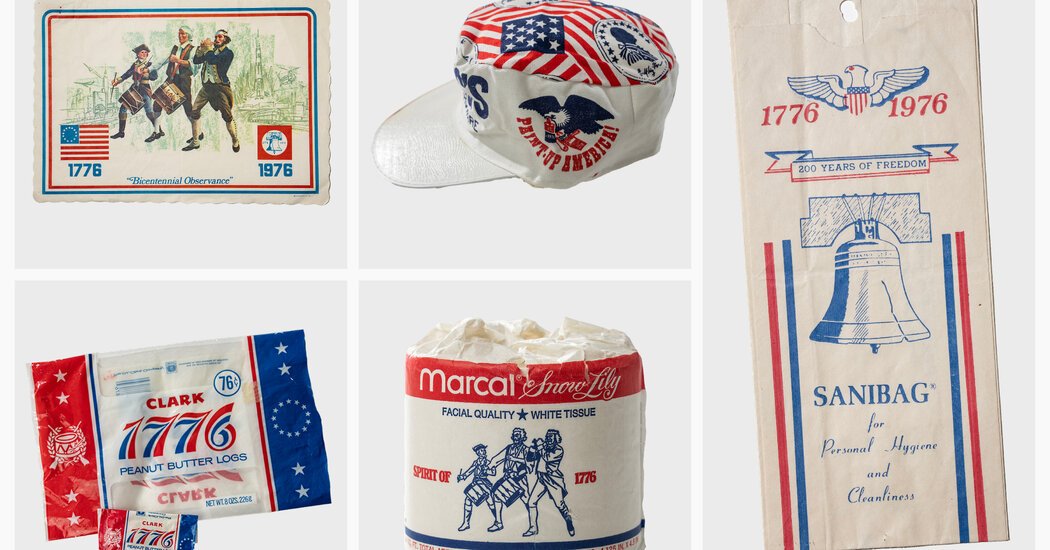
The Bicentennial Schlock collection, totaling just over 100 artifacts, is one of Yale’s quirkier holdings. Assembled in 1976 by the historian Jesse Lemisch, it endures as a lively (if a bit grungy) testament to the star-spangled commercialism that swept across the country in the run-up to the 200th anniversary of American independence.
Today, it can be hard to grasp the scale of the swag. By the time the confetti stopped falling, according to one estimate, more than 25,000 items had been produced, from a limited-edition replica of George Washington’s sword to independence-themed toilet paper.
This being the 1970s, the commercialism prompted a countercultural pushback, along with charges that “Buy-centennial” huckersterism had sold out the true radical spirit of ’76.
“You know damn well that we’re going to be inundated for two years with an attempt to sell a plastic image of America to sell cars and cornflakes,” the activist Jeremy Rifkin, a founder of the People’s Bicentennial Commission, an anti-corporate group, told The New York Times in 1974. “To me that’s treason.”
Lemisch, as a lifelong man of the left, was politically sympathetic. But as both a scholar and a self-described “terminal Bicentennial freak,” he also saw an opportunity.
“How many of us,” he wrote in The New Republic in 1976, “are lucky enough to see the central passion of our creative lives translated into the Disney version, and for sale, in this translation, in every supermarket?”
Lemisch, who died in 2018, was not the only one cataloging the goofier manifestations of the Bicentennial. The Gerald R. Ford Presidential Library and Museum in Grand Rapids, Mich., has a trove of memorabilia, including a can of “Bicentennial air.” And the University of Central Florida has a “Bicentennial Junk” collection. But Lemisch’s comes with an intellectual pedigree forged in the history wars of the ’60s and ’70s.
Lemisch, who got his doctorate from Yale in 1963, was part of a generation of social historians who challenged both the conservative bent of scholarship on early America and what they saw as the historical profession’s complacent, complicit relationship with American power.
In his influential 1967 essay “The American Revolution Seen From the Bottom Up,” he argued that the Revolution wasn’t just a top-down affair but also a genuinely democratic uprising driven by the aspirations of the artisan and working classes, which were ultimately thwarted by wealthy elites.
He also pushed for democratization of the archival record. In a 1971 essay called “The American Revolution Bicentennial and the Papers of Great White Men,” Lemisch lamented that the ambitious and well-funded scholarly editing projects undertaken for the anniversary neglected rabble-rousers like Thomas Paine and Sam Adams, to say nothing of women, Black Americans and Native Americans.
Those projects, he argued, reflected the “arrogant nationalism and elitism” of the 1950s that historians, like the nation itself, were already leaving behind.
The schlock collection had its origins in an undergraduate class Lemisch taught at the State University of New York, Buffalo, in the spring of 1976. The course included scholarly reading, but Lemisch also instructed the students to gather as much Bicentennial junk as they could find.
“We owe it to Those Who Will Come After Us to preserve and interpret these priceless relics,” he wrote in his syllabus. “Let us fill a time capsule with a deeply embarrassing heritage for 2076.”
Forget the quality commemorative items from the Franklin Mint and Colonial Williamsburg. He wanted “real schlock, available schlock, cheap schlock,” ideally costing less than a dollar. And it needed to be properly documented.
“Please,” he wrote, “do not bury me in unannotated schlock!”
Lemisch and his students organized a museum-style exhibition in Buffalo in October 1976. As news stories about this unlikely “Schlock Czar” spread, he started getting fan letters from people across the country, along with additional specimens.
A woman from Brooklyn sent “a piece of Bicentennial Patriotism good enough to eat.” A woman from Muncie, Ind., contributed stars-and-stripes paper surgical caps worn, to her surprise, by the team that had recently operated on her.
Two correspondents sent Lemisch the identical sanitary disposal bags, printed with the Liberty Bell, that had suddenly appeared in the women’s bathroom in their campus library.
“Although the Bicentennial has passed, I can still remember my amazement at being confronted with ‘200 Years of Freedom’ upon entering the toilet,” a student at Rutgers wrote.
At first Lemisch reveled in the public interest. But the attention — someone in San Jose, Calif., he claimed, had even named an omelet after him — left him feeling ambivalent.
“By the time I cut off the interviews,” he wrote in The New Republic that November, “I had become Bicentennial Schlock.”
Still, he staged a revival of the exhibition in New York City in August 1977, at the headquarters of a union. In 1981, he donated the collection to Yale.
“I believe that future researchers will find the material a distinctive collection for reconstructing Americans’ views of the past in 1976,” he wrote at the time.
Since then, Cochran said, it has seen use by classes and researchers. And an Uncle Sam Pez dispenser is currently on view in the Beinecke’s new exhibition, “Unfurling the Flag: Reflections on Patriotism,” alongside non-schlock like Yale’s first printing of the Declaration and a typescript draft of Langston Hughes’s poem “Let America Be America Again.”
“We want to prompt people to think about where their ideas about patriotism come from,” Cochran said. “The Bicentennial was a formative moment for a lot of people, when the iconography was inescapable.”
Today, you can find the same Pez dispenser on eBay, along with tens of thousands of Bicentennial listings running heavily to coins, stamps, plates and ersatz Paul Revere pewter. But Lemisch’s collection includes many items so lowly — wet wipes, dry-cleaning bags, plastic straws in patriotic sleeves — that they may survive nowhere else.
Patriotic Dixie cups and cereal boxes might seem to epitomize the kind of populist “history from below” that Lemisch championed. But he saw things differently.
Bicentennial schlock, Lemisch wrote in The New Republic, had “floated down from above, and responded to no popular longing to celebrate the Bicentennial.” It was “the Watergate of patriotism” — a “healthy demystification” that made Americans “wisely cynical” about the official history they were peddled.
“Since Schlock was the Bicentennial’s most pervasive manifestation and perhaps its most enduring heritage,” he wrote, “it almost seems, emotionally speaking, as if there was no Bicentennial at all.”
Today, historians take a more sanguine view. For all its tensions and contradictions, they argue, the Bicentennial added up a powerful cultural moment. It spawned both new scholarship and a boom in popular history, powered by a more emotional, personal way of relating to the past. And Lemisch’s deadpan museum — along with the delighted public response to it — was very much a part of it.
And this year’s Semiquincentennial? Then, as now, there has been debate over its focus and political meaning, which has intensified as President Trump has moved to put his own stamp on the anniversary. And while there are plenty of exhibitions and events on tap across the country, there has been much less investment and enthusiasm overall.
Which isn’t to say there is no merch. The websites for both America250, the nonpartisan federal planning group created by Congress in 2016, and Freedom 250, an alternate effort backed by President Trump, offer tasteful hats, mugs, playing cards and pickleball paddles. But so far, unapologetic 1976-style schlock appears thin on the ground.
You could chalk the schlock gap up to shifts in consumer culture, growing political polarization or the fact that schlock — or slop? — has moved online. But even back in 1976, Professor Lemisch struggled to draw definitive conclusions.
“What does Bicentennial Schlock mean?” he wrote. “I don’t exactly know. I find that deeply embarrassing.”
“More research,” he added, “is needed.”