
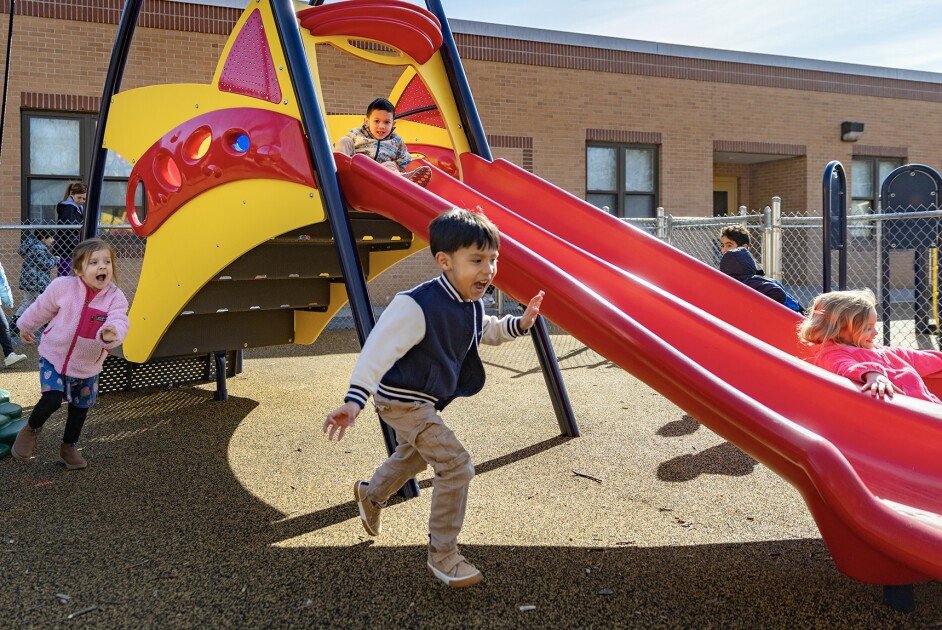
A new law in Oklahoma will double the minimum amount of time elementary school students will spend at recess starting next school year, a divergence from a trend of schools in recent years slashing time for unstructured play.
The new law, signed by Republican Gov. Kevin Stitt this month, requires at least 40 minutes of recess per day for students in grades K-5, up from 20 minutes.
Evidence from the U.S. Centers for Disease Control and Prevention and other researchers shows multiple benefits that recess can bring to students from elementary through high school: improved academic outcomes, social and emotional learning, and boosts in overall well-being.
But most states don’t require daily recess, and state-level surveys have shown recess time declining in the past two decades, typically in favor of more instructional time.
Additionally, many states do not prohibit withholding recess as a punishment. Oklahoma’s new law now outlaws that practice.
In the 2001-02 school year, elementary students spent an average of 36.8 minutes per day on playgrounds, according to a study by the Center on Education Policy. Now, the average amount of recess in elementary school is 20-30 minutes, according to the CDC.
By the time students reach the upper grades, they may get no built-in recess breaks at all. In a 2025 EdWeek Research Center survey, 80% of high school teachers and 49% of middle school teachers reported that their students had no recess time.
All elementary teachers surveyed agreed that their students need recess. Thirty-six percent indicated that 21-30 minutes daily is the ideal amount of time, while a quarter said 31-45 minutes. Fifteen percent put the ideal amount of daily recess at 46-60 minutes.
Despite the widespread trend toward less recess time, some states in recent years have tried to reverse course.
Kansas lawmakers this month passed legislation to require 30 minutes of recess daily for elementary students and to bar schools from withholding recess as punishment. It also would have required that schools administer fitness tests to students, but Democratic Gov. Laura Kelly vetoed it, saying the state board of education was working to institute these changes.
Meanwhile, Ohio and Wisconsin lawmakers are considering similar proposals to Oklahoma’s to expand recess requirements, and California last year implemented a law requiring at least 30 minutes of recess per day for students through 6th grade.
But educators have raised concerns about the cost of losing instructional time and have said it is difficult to fit recess into the schedule while meeting other state class-time requirements and pressure to get through a year’s worth of content for standardized testing—a sentiment shared by some district leaders in Oklahoma as its new recess-time law takes effect, according to local reporting.
Under Oklahoma’s new law, elementary schools can hold two, 20-minute recesses to satisfy the state requirement.
“The broader concern … is the continued tendency to add to the academic day without making corresponding reductions elsewhere,” Jason Perez, the superintendent of the Deer Creek district in Oklahoma, told the Oklahoma Voice.
Another challenge: Many schools don’t have access to playground equipment that students can use in extreme weather.
One study, for example, found that less than 1% of public schools in California have adequate shade for outdoor recess, meaning that when temperatures rise, there’s no safe place to play.
Under-resourced schools are less likely to have spaces such as shade-sheltered outdoor areas to safely offer recess in extreme heat, which can lead to inequitable access to unstructured play, according to the study.
In Oklahoma, the increase in recess time dovetails with recent legislation to ban cellphones in school, including during recess periods. Lawmakers say it’s a natural progression: More movement at recess allows kids to release pent-up energy in a productive way, in turn helping them focus better in class.
“Of course, we think of it as play, but it also has many health benefits, many mental health benefits,” Oklahoma state Sen. Ally Seifried, a Republican who sponsored the legislation, told local media. “You learn conflict resolution. You learn how to play with your friends. But it really gives them that mental break so that then when they come back into the classroom, they can fully be focused.”