
Inertia Enterprises Signs Agreements with Lawrence Livermore National Laboratory for Laser-Based Fusion Reactor Development
Inertia Enterprises, a fusion power startup, announced on Tuesday that it has entered into three agreements with the Lawrence Livermore National Laboratory (LLNL) to collaborate on bringing the laser-based fusion reactor developed at the lab to the commercial market.
The collaboration with LLNL positions Inertia ahead of its competitors in the fusion power industry. LLNL’s National Ignition Facility (NIF) is the only facility that has successfully demonstrated controlled fusion reactions producing more power than they consume. Inertia made a significant entrance into the industry earlier this year with a substantial $450 million Series A funding round, making it one of the most well-funded startups in the field.
Inertia and LLNL are focused on advancing inertial confinement fusion, a method that involves compressing a fuel pellet with an external force to initiate fusion reactions. This approach differs from other fusion methods that rely on magnetic fields to contain plasmas during the fusion process.
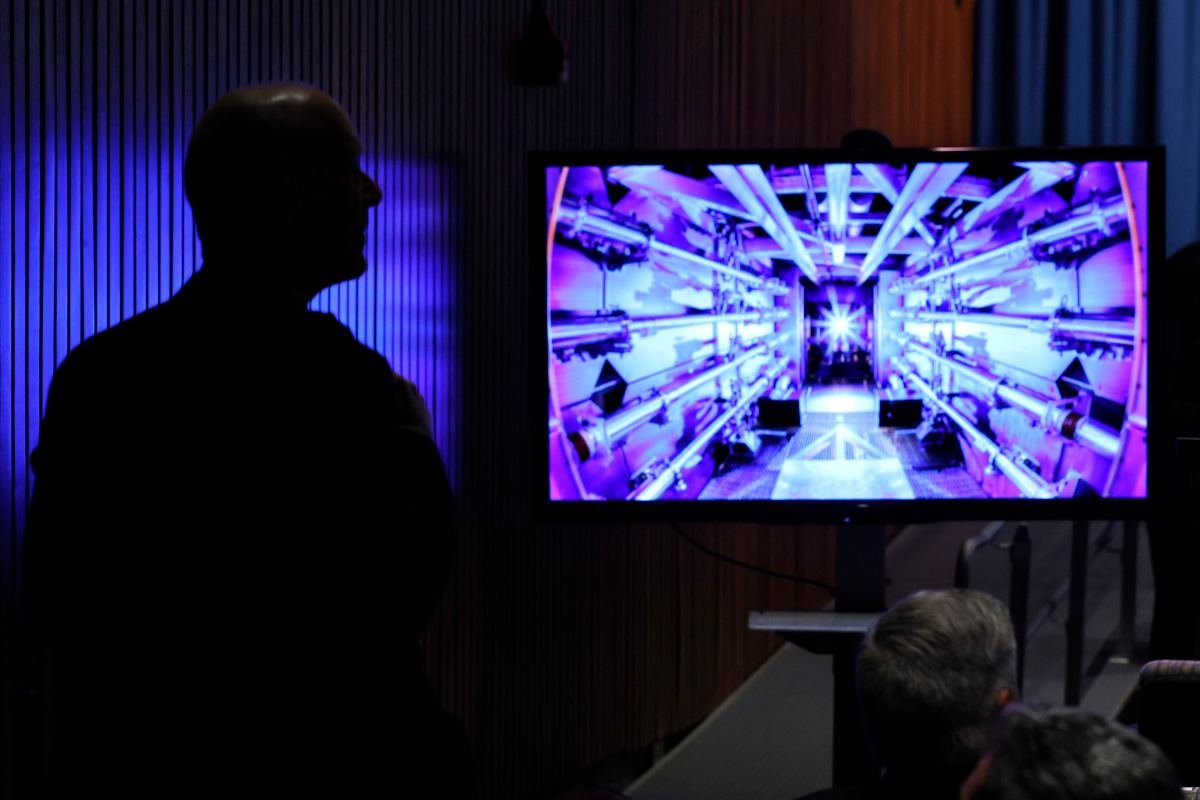
At the NIF, 192 laser beams are directed into a vacuum chamber to converge on a hohlraum, a small gold cylinder containing a fuel pellet coated with diamond. The lasers vaporize the hohlraum, generating X-rays that compress the fuel pellet. The diamond coating transforms into plasma, further compressing the deuterium-tritium fuel inside the pellet.
The process at NIF must be repeated multiple times per second for the technology to potentially generate power for the grid.
The concept of a laser-driven fusion reactor was initially developed in the 1960s for researching thermonuclear weapons in a safer manner, with the added potential for power generation. Construction of the NIF began in 1997, and after 25 years, the facility achieved the milestone where the fusion reactions produced more energy than was needed to initiate them.
Several startups, including Inertia, Xcimer, Focused Energy, and First Light, are now striving to scale up the laser-driven fusion reactor concept into commercial power plants. By leveraging newer, more efficient laser technologies, these startups aim to reduce the energy input required for each fusion reaction, potentially making commercial fusion power plants more economically viable.
Strategic Partnerships and Research Agreements
The agreements between Inertia and LLNL encompass two strategic partnership projects and a cooperative research and development agreement. The collaboration aims to enhance laser technologies and improve fuel targets to enhance performance and manufacturing processes. Inertia has also secured licenses for nearly 200 patents from LLNL.
It was a natural progression for Inertia and LLNL to continue collaborating, especially considering that Annie Kritcher, the co-founder and chief scientist of Inertia, played a key role in designing the successful experiment at NIF that achieved scientific breakeven. The enactment of the 2022 CHIPS and Science Act facilitated Kritcher’s transition to founding Inertia while maintaining her position at LLNL.