
Today’s post wraps up a series on ways educators can support students’ mental health.
Responding to Adverse Childhood Experiences
Linda C. Mayes, M.D., is a developmental pediatrician at the Yale School of Medicine where she leads the Yale Child Study Center. She is the co-author, with Dr. Michele Myers, of The Educator’s Guide to Building Child & Family Resilience (Scholastic, 2023):
Two decades ago, few were talking about trauma or adversity and considering the lasting impact it can have on children. Thankfully, today, most educators understand that many of their students have experienced distressing adversity and know that it can present many challenges in the years to come.
Adverse childhood experiences, coined as “ACEs,” fall into three categories: abuse, neglect, and household dysfunction. They can have a cumulative, long-lasting effect on a child’s development, whether physical, mental, or emotional. It is critical that when students come into the classroom, we as educators and leaders cultivate environments that support student growth, safety, and resilience, so that these children may find rest and relief. Below, I share three strategies districts, schools, and teachers can implement from the ground up to support student mental health.
- Understand where kids are coming from
In recent years, children have witnessed a global pandemic that has contributed to widescale societal disruption. Many kids have experienced unspeakable trauma and disruption to their daily lives, routines, education, and relationships, which has impacted their development in many areas.
We know from research that with unremitting stress, children’s brains may become wired to respond quickly to any perceived potential danger, which may result in their having trouble paying attention, following directions, and acting out in class. While we as educators have our own stressors, by nature of our profession, we must continue to show children that while we may not be able to remove or control negative experiences, we can most certainly provide positive support in a child’s world.
- Creating welcoming environments
Through providing a nurturing environment and fostering a classroom climate that is welcoming, compassionate, and calm, we can provide children with resilience-promoting capacities. One simple way to encourage children in any learning environment is to allow them to ask questions and to be curious about the world around them. When we show students that curiosity is welcome, kids gain an important skill that they can use in their day-to-day lives to help them make sense of events, behaviors, and circumstances.
Studies show that mindful and curious people are more receptive to information that may be initially challenging (Kawamoto et al., 2017). Simply put, people who are curious are more inclined to think flexibly. A resilience-informed educator knows that when students are given the opportunity to be curious and about what they are learning, they are more likely to become focused on their learning, solution-oriented, and motivated.
- Demonstrating and practicing altruism
While this may seem like an obvious point, demonstrating prosocial behavior such as altruism can be highly effective in showing children how to be more empathetic and kind toward others. The Yale Child Study Center-Scholastic Collaborative for Child & Family Resilience defines altruism as acts for the benefit of family, friends, and community without an expectation of something in return. By implementing opportunities to volunteer, performing random acts of kindness, or donating to others, children can witness a powerful lesson in compassion.
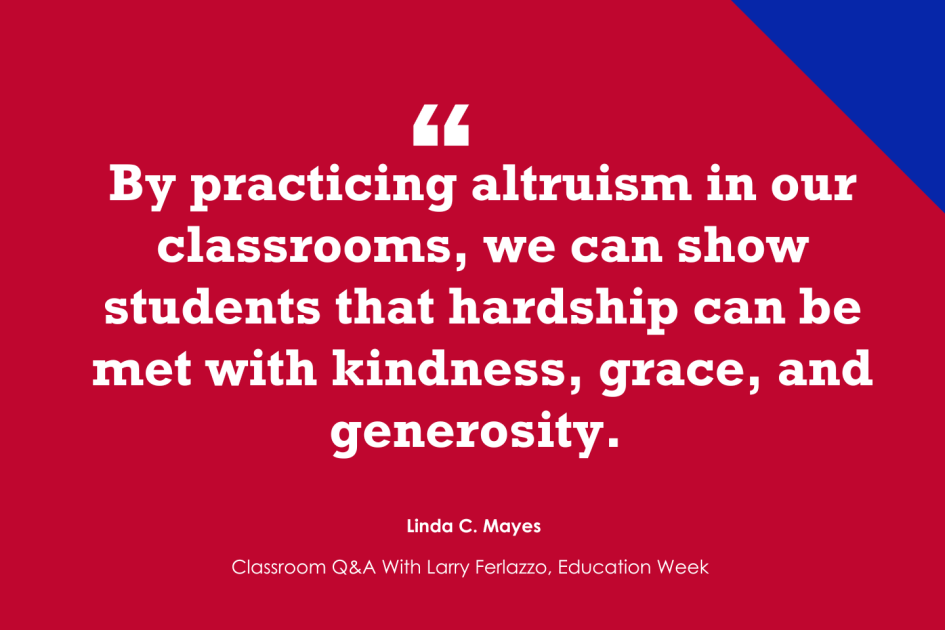
As previously mentioned, helping students navigate their mental health starts with adding more positive support into their lives. By practicing altruism in our classrooms, we can show students that hardship can be met with kindness, grace, and generosity.

Thanks to Linda for contributing her thoughts!
Today’s post answered this question:
What are the best ways districts, schools, and teachers can support students’ mental health?
In Part One, Ron Berger, Craig Aarons-Martin, and Renee Jones shared their ideas.
Consider contributing a question to be answered in a future post. You can send one to me at lferlazzo@epe.org. When you send it in, let me know if I can use your real name if it’s selected or if you’d prefer remaining anonymous and have a pseudonym in mind.
You can also contact me on X at @Larryferlazzo or on Bluesky at @larryferlazzo.bsky.social .
Just a reminder; you can subscribe and receive updates from this blog via email. And if you missed any of the highlights from the first 13 years of this blog, you can see a categorized list here.