
Retrieval-Augmented Generation as a Service (RAGaaS) is revolutionizing how businesses utilize AI for real-time, context-aware responses. But have you ever wondered how it accomplishes this and why businesses shy away from custom RAG system development? This article aims to address all your queries, covering everything from the definition of RAGaaS to its importance for businesses, as well as the advantages, use cases, and illustrations.
In recent years, the emergence of powerful conversational AI tools like ChatGPT has sparked discussions across various industries about generative AI, large language models (LLMs), and other AI solutions. Businesses are seeking ways to leverage AI trends to enhance their operations, with tech companies offering assistance in automating tasks and implementing artificial intelligence.
However, standalone LLM solutions encounter challenges in distinguishing between factual information and assumed facts, leading to instances where they appear to possess all knowledge. These systems also struggle to keep up with rapidly changing enterprise data. The solution lies in constructing custom AI pipelines, RAG solutions, and utilizing data science solutions. However, this process is arduous, expensive, and time-consuming.
This is where RAG as a Service (RAGaaS) comes into play. Instead of investing substantial sums of money in developing a RAG solution, businesses can access scalable, secure, and high-performance RAG solutions through RAGaaS. This eliminates the need for heavy investments in infrastructure.
But how does RAGaaS achieve this? This article will address all your key concerns, including:
- What RAG as a Service entails for businesses
- The core components that drive its functionality
- The business benefits and ROI impact it offers
- Real-world use cases and examples across various industries
Therefore, if you are a CTO, CIO, or AI product owner seeking to minimize risk and expedite AI adoption, this guide is tailor-made for you.
What is RAG as a Service?
Similar to Software as a Service (SaaS) and AI as a Service, RAG as a Service, also known as RAGaaS, provides businesses with a suite of managed services and solutions (in the form of APIs) that enable them to integrate retrieval with LLMs to generate accurate, fact-based, up-to-date, and contextually relevant AI responses from the dataset used to train its models.
Rather than requiring businesses to make substantial upfront investments in in-house infrastructure and custom solutions, RAGaaS allows them to entrust all concerns regarding model and data management to the service provider. The RAGaaS provider handles everything, including data ingestion, indexing, retrieval, and integration with LLMs and Generative AI use cases.
By leveraging RAGaaS, businesses can personalize and integrate the RAG pipeline with applications such as chatbots, search tools, and more, making them intelligent without the need to hire machine learning developers.
How RAG as a Service Works
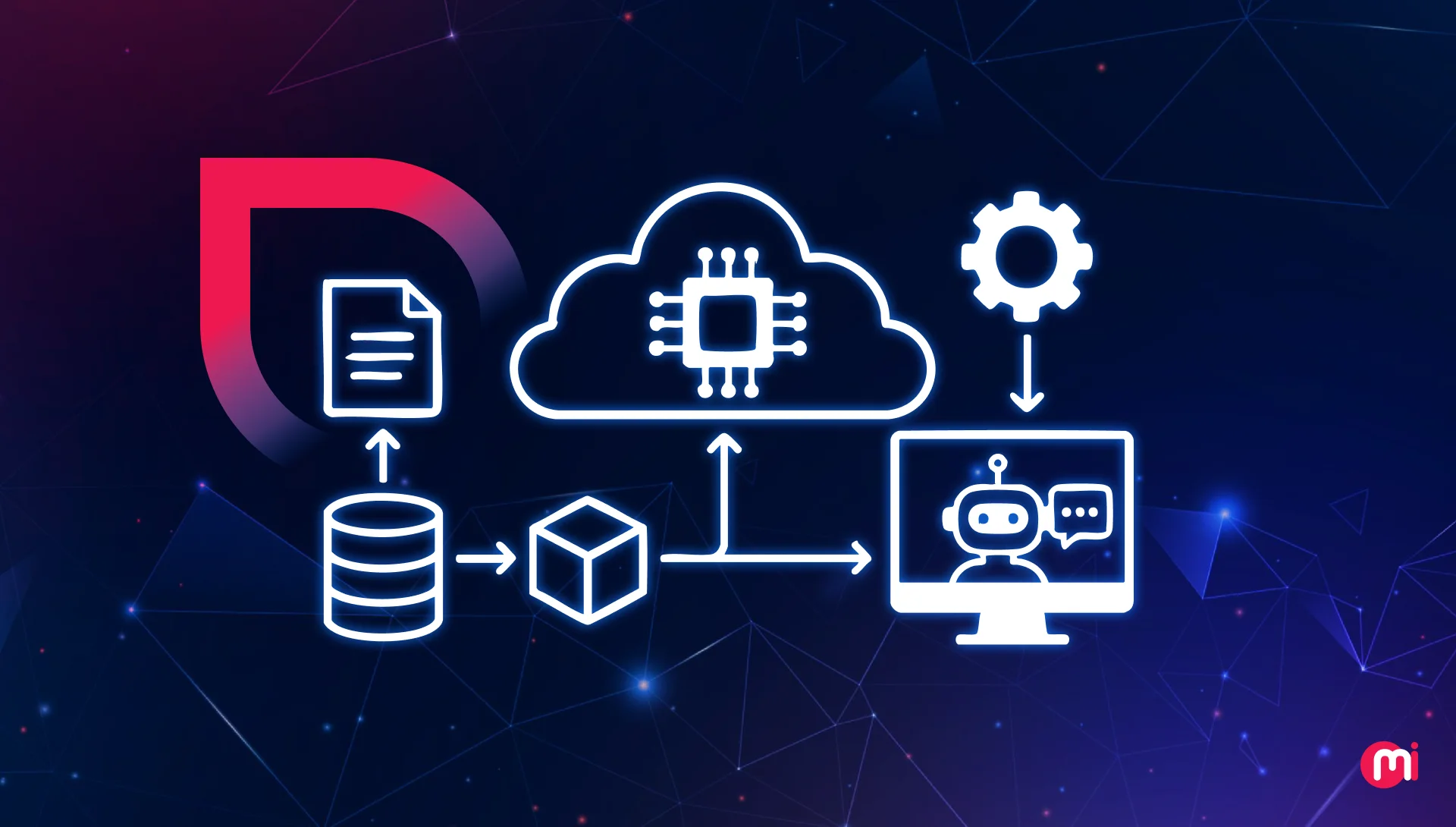
RAG as a Service amalgamates processes like data ingestion and indexing, retrieval mechanism, generation mechanism, and integration & deployment through its fully managed solution to streamline the development and maintenance of RAG pipelines.
Here’s how each component of RAGaaS contributes:
- Data Ingestion and Indexing
Enterprise data may exist in a structured or unstructured format, encompassing documents, PDFs, knowledge bases, CRM data, and more. Through preprocessing, unstructured data is cleansed, structured, and transformed into embeddings (mathematical representations). These embeddings are subsequently indexed in a vector database, facilitating swift and accurate semantic search. Subsequently, chunking is performed to break down documents or large datasets into smaller, manageable fragments for more efficient retrieval. Essentially, this step revolves around making your knowledge easily searchable. - Retrieval Mechanism
Commonly referred to as a retrieval layer or mechanism, this component aids in locating the appropriate context in real-time. When a user issues a query, the retrieval mechanism conducts a similarity/semantic search in vector databases to retrieve the most relevant information chunks from the indexed data and delivers high-precision, domain-specific context in response. It also leverages the rethinking model to further hone the results, ensuring only the most relevant data snippets are relayed. - Generation Mechanism
This mechanism employs augmentation to combine the retrieval context with the original prompt, creating a richer and more contextualized input. Subsequently, an LLM such as GPT or LLaMA utilizes this augmented prompt to generate a comprehensive and accurate natural language response based on the provided context. By utilizing the context from the retrieval layer, hallucinations are significantly reduced. Consequently, your AI is imbued with both the precision of retrieval and the fluency of generative AI, enabling it to furnish reliable, on-brand, and validated answers consistently. - Integration and Deployment
The generated response is ultimately dispensed to users through integrated customized APIs, chatbots, an enterprise dashboard, or voice assistants. As RAGaaS is being leveraged, you can rest assured about its security, governance, monitoring, and scalability, as these aspects are managed by the provider.Top Benefits of RAG as a Service
Businesses should contemplate embracing RAG as a service due to the advantages it offers in terms of speed, cost, compliance, customer experience, and more. Here are the primary benefits of considering RAG as a service to implement AI in enterprise-grade processes:
- Competitive Advantage
RAG platforms furnish pre-built, plug-and-play RAG pipelines, reducing the time and effort entailed in AI development solutions and enabling you to launch them swiftly, thereby outperforming competitors. - Lower TCO vs. Custom RAG
Constructing and sustaining a custom RAG solution is costly, as it necessitates investments in vector databases, embeddings, orchestration, security, and more. Opting for RAGaaS obviates the expenses associated with infrastructure, development, and maintenance by up to 40%. Thus, with RAG as a service, you only pay for what you utilize, enhancing budget predictability. - Higher CSAT and Fewer Errors
RAG as a service facilitates the delivery of accurate and context-aware responses, enhancing first contact resolution (FCR) and customer satisfaction while reducing escalations and support costs. - Reduced Hallucinations
Hallucinations in AI not only engender trust issues and inconveniences but also pose compliance risks and ultimately harm reputation. With pre-trained, customizable, and ready-to-integrate RAG services, you can ensure that every AI response is sourced from verified data, significantly reducing hallucinations. - Enterprise-Grade Security
The majority of RAG service providers ensure that their platforms adhere to specific industry compliance standards like ISO 27001, SOC2 Type 2, GDPR, HIPAA, and others. By selecting RAGaaS after verifying compliance details, you avoid security concerns, as the platform and service provider handle data encryption, access controls, and compliance, preventing sensitive data leaks and providing full audit trails. - Scalability and Modularity
Scaling custom RAG solutions often necessitates investments in developers and infrastructure. In contrast, scaling with RAGaaS is effortless. You need not rebuild RAG pipelines; instead, you can add new data sources or modules for seamless scaling. Consequently, RAGaaS is ideal for rapidly expanding enterprises. - Improved Data Control
Unlike open LLMs that operate as black boxes, RAGaaS grants you control over indexed, retrieved, and generated data. Thus, while the service is managed, you can uphold data residency and customize relevance rules. - Traceable & Validated Responses
RAGaaS ensures that users receive responses tied to specific authoritative sources, offering a means to verify information and instill trust in the AI’s output.Key Use Cases of RAG as a Service
RAG-as-a-Service functions as an intelligent layer that merges real-time data retrieval with generative reasoning to furnish accurate answers, contextual insights, and intelligent decision support across various domains.
Here are the primary use cases of RAG as a service:
- Customer Support Automation
RAGaaS integrates your knowledge base, FAQs, and past interactions into an AI model that delivers precise answers to customer queries in real-time. It retrieves the latest product or policy updates from internal systems, ensuring responses are always up to date. - Compliance Monitoring in Finance
For banks and investment firms, adhering to changing regulations is imperative. By integrating RAGaaS with their financial system, these institutions can retrieve clauses from regulatory documents and cross-reference them with internal policies to alert teams to discrepancies. - Clinical Decision Support in Healthcare
Healthcare professionals require accurate, evidence-based answers promptly. By integrating RAGaaS with a comprehensive healthcare system, they can retrieve the latest medical research, treatment guidelines, and patient history from Electronic Health Record (EHR) systems to support precise diagnoses and treatment plans. - Internal Knowledge Management
Businesses often encounter numerous employee queries regarding HR policies, upcoming events, project specifics, and more. RAGaaS can centralize key workplace data related to policies, projects, and more in a role-based manner. This integration enables the business knowledge system to retrieve information from all connected documents and repositories, delivering context-aware responses while adhering to data privacy and governance requirements. - Contract Review & Legal Analysis
Legal teams grapple with a vast volume of contracts, outdated search tools, regulatory changes, and time-consuming manual reviews. By integrating RAGaaS with their digital interface, legal firms can swiftly extract clauses, compare terms, and flag risks across numerous contracts, thereby enhancing efficiency and accuracy. - Fraud Detection & Risk Assessment
Industries like finance, insurance, and healthcare face significant losses due to fraud. By integrating RAGaaS with their systems, these entities can analyze transaction histories, customer profiles, and external risk databases to detect suspicious activity and provide real-time explanations for flagged transactions. - Medical Research & Drug Development Assistance
Researchers in the medical and pharmaceutical fields must navigate vast amounts of complex, unstructured data. RAGaaS can retrieve the latest research papers, clinical guidelines, and patient data, delivering precise and up-to-date medical information to facilitate research and drug development. - Supply Chain Optimization
Supply chains generate copious amounts of data from various sources, which traditional AI models and general-purpose LLMs struggle to process effectively. RAG services enhance supply chains by connecting LLMs to external, real-time data sources, enabling accurate, contextualized insights and automation for tasks like demand forecasting, route optimization, risk management, and inventory management.In essence, integrating RAG services enhances supply chain software with proactive decision-making, cost reduction, improved operational efficiency, and better resilience to disruptions.
Examples of RAG as a Service Platforms
Leading RAG-as-a-Service (RAGaaS) providers such as Amazon Bedrock, Nuclia, Vectara, and Personal AI offer managed services and integrated tools for building and customizing RAG applications.
Let’s delve deeper into these prominent RAGaaS platform providers:
Amazon Bedrock
Backed by AWS, Amazon Bedrock provides comprehensive support for end-to-end RAG workflows through its Knowledge Bases and foundation models. This service includes built-in session context management and source attribution, enabling the development of RAG workflows from data ingestion to retrieval and prompt engineering without the need to manage infrastructure or custom integrations around data pipelines. Additionally, it features built-in managed natural language capabilities to help the engine understand query context and retrieve data without requiring an additional data warehouse.Vectara
Designed specifically for RAG, Vectara adopts an API-first approach that covers data ingestion, chunking, embeddings, and LLM orchestration. Its privacy-centric design, zero data retention, compliance with SOC 2 Type 2, HIPAA, and GDPR, and support for OAuth 2.0 and API keys make it ideal for businesses handling sensitive data in sectors like legal, healthcare, and finance. Vectara offers advanced vector storage, intelligent hybrid search, and custom filters in its DIY RAG platform, empowering businesses to develop fast and hallucination-free RAG-powered solutions like AI assistants and agents trained on their data.Nuclia
Nuclia serves as an all-inclusive RAG as a service platform, delivering a modular RAG solution that can be customized to suit specific business use cases. It automates file and document indexing from internal and external sources to train LLMs, ensuring hallucination-free responses to queries. Its compliance with SOC 2 Type 2 and ISO 27001 standards makes it an ideal managed RAG service for businesses requiring reliability.Pinecone
Pinecone stands out as the most widely adopted vector database powering RAG pipelines at scale. Renowned for its high-performance vector search and multi-cloud flexibility, Pinecone is favored by developers constructing large-scale, retrieval-driven applications with guaranteed low-latency search capabilities.Wrapping Up
Embracing Retrieval-Augmented Generation as a Service (RAGaaS) entails embracing a transformation in how businesses interact with knowledge. By doing so, you sidestep the complexities associated with constructing and maintaining your own retrieval pipelines, vector databases, and finely-tuned models. Instead, you gain access to a scalable, secure, and pre-optimized solution that seamlessly integrates into your tech stack.
Whether it involves automating compliance, enhancing customer support, or empowering data-driven decisions across your enterprise, RAGaaS enables you to launch swiftly, reduce costs, and unlock tangible business outcomes without investing months in custom development.
MindInventory: Your Partner in Building and Integrating RAGaaS Solutions
Developing RAG solutions necessitates a profound understanding and extensive expertise in constructing Generative AI solutions. MindInventory, a leading Generative AI development company, brings precisely that to the table.
Here’s why you should opt for MindInventory:
- Data Ingestion and Indexing
- Our team comprises specialists in OpenAI, Google Vertex AI, AWS AI, and Microsoft Azure AI, ensuring your solution leverages the appropriate models and infrastructure for your business objectives.
- With certified cloud & AI engineers onboard, we design scalable, secure, and high-performing RAGaaS platforms tailored for enterprise-grade workloads.
- We provide end-to-end development & integration support, enabling you to focus on your core business competencies while entrusting all AI development concerns to us.
- Whether you intend to integrate RAGaaS into your existing systems or develop a comprehensive RAGaaS platform as your product, we possess the expertise and infrastructure to bring your vision to life.
FAQs About RAG-as-a-Service
Why do businesses need RAG as a Service?
Businesses require RAGaaS as it eliminates the challenges associated with custom RAG system development, such as high costs, slow time-to-market, scalability issues, security risks, and continuous optimization needs. By opting for RAGaaS, businesses benefit from a secure, scalable, and readily available solution that furnishes accurate, context-aware responses without the burden of infrastructure, compliance, and ongoing optimization.What does great RAG as a Service look like in practice?
Exceptional RAGaaS amalgamates structured and unstructured enterprise data with retrieval-augmented AI models to provide fast query resolution, context-aware answers, API-based integration, and scalability while upholding security and compliance.Why should you choose RAG as a service instead of a custom RAG implementation?
Opting for RAG as a service over custom RAG implementation offers advantages like rapid deployment, reduced infrastructure management and MLOps overhead, and enhanced flexibility, enabling your team to concentrate on product development rather than complex pipeline maintenance.Does RAGaaS ensure data privacy & compliance?
Yes, leading RAGaaS providers ensure end-to-end encryption, role-based access, and compliance with GDPR, HIPAA, SOC 2, and other standards, rendering it safe for industries handling sensitive information like healthcare and finance.What industries benefit most from RAGaaS?
Industries such as healthcare, finance, legal, retail, and supply chain, which manage vast, complex, and frequently updated data, derive the greatest benefits from RAGaaS.What’s the difference between Retrieval-Augmented Generation and semantic search?
Semantic search locates relevant documents, while RAG goes a step further by combining retrieval with LLM-powered generation to produce context-rich, conversational answers instead of mere links.How is RAG as a Service different from Fine-tuning?
Fine-tuning modifies model weights with new training data, making it costly and static. RAG, on the other hand, retrieves fresh data from external sources in real time, furnishing dynamic, accurate answers without necessitating model retraining.Is RAG better than fine-tuning?
For most businesses, RAG surpasses fine-tuning in dynamic knowledge updates and cost-efficiency since it doesn’t require retraining. Fine-tuning is beneficial for static, highly specialized tasks, whereas RAG offers superior flexibility and scalability.In conclusion, integrating RAGaaS into your business operations can yield significant benefits in terms of efficiency, accuracy, compliance, and customer satisfaction. By partnering with a reputable provider and leveraging the power of RAGaaS, businesses can stay ahead of the curve in the ever-evolving landscape of AI technology.