
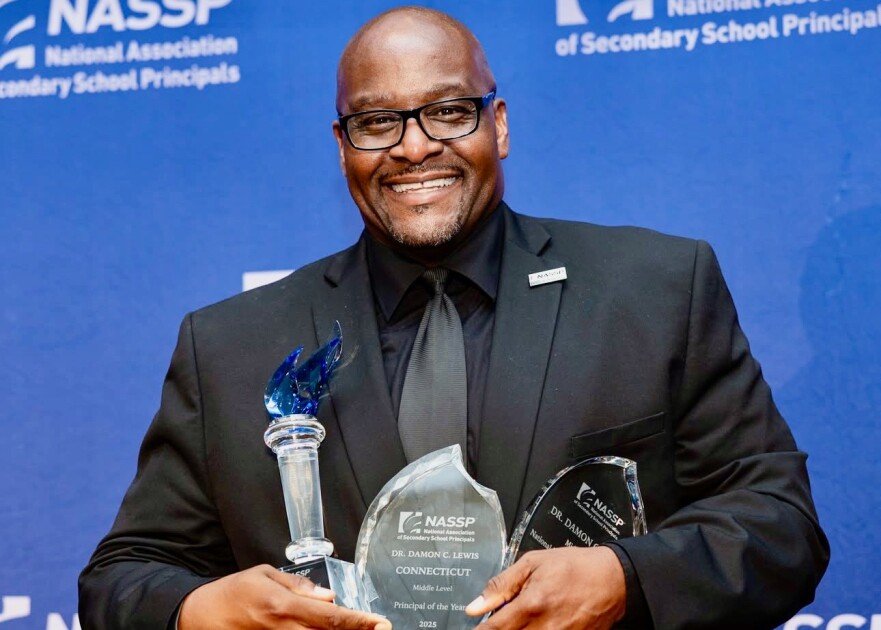
Damon Lewis, the principal for Ponus Ridge STEAM Academy in Norwalk, Conn., believes nurturing positive relationships between students and staff is central to creating a safe and supportive learning environment.
“If you can engage kids on a social level, they’re going to be more open, more apt to participate, because they know [their teacher] has a deeper understanding of who they are and where they come from,” said Lewis, the National Middle Level Principal of the Year in 2025.
Research shows that a positive school climate helps keeps young people engaged in school, improving students’ education outcomes and well-being during their academic careers and beyond.
In a phone interview with Education Week, Lewis discussed how he and his staff attempt to create those sorts of conditions in their school.
This interview has been edited for length and clarity.
How are you trying to build and maintain a positive school climate?
We do something called relationship mapping, where our 8th grade teachers send out a survey, and they ask the 8th grade students to list two or three trusted adults in the building that they feel comfortable with. From that, we match kids with staff members in the building so they’re comfortable at all times. That may be a homeroom shift, … so you have someone when you first come into the building, who you can talk with and who you trust. That’s gone a really long way. [Students in 6th and 7th grades do other team-building and town-hall-style activities to get to know the adults in the building.]
We really put a big emphasis on an acronym that we came up with, RBC—relationships before content. It’s something as simple as teachers, after every period, standing outside their door in the hallway, interacting with every kid that comes down their hallway, even the kids not in their classroom. When the kids come into the classroom, a lot of the teachers take two or three minutes before they get started and get into what kids are doing, what activities they’re involved in after school, and why they like it, and ways that we can improve upon the things that we offer.
We’re going to get to the standards and standards-aligned tasks, but we have to make sure that our kids feel safe enough to come into our building and have a trusted adult in the building who they can talk to at any given moment.
How did you get teacher buy-in on the focus on relationships?
There’s one thing that happens in our building without any kind of pushback: It’s that we all know that we are there for the kids—the development of kids—and our families. So [I am] fully transparent and direct, and tell teachers, “Make sure you’re in the hallway between classes, meeting and greeting kids, asking how they’re doing and knowing what that student needs in that specific class.”
And you have to inspect what you expect. I do a lot of hall duty and cafeteria duty. I actually see this work in action. It’s not [as though] I send out a transparent email about meeting and greeting kids, and then I go hide in my office.
What kind of training do teachers receive?
There’s no formal training. It’s simple conversation starters or sentence stems. We talk about it in faculty meetings: how we engage kids, not just in our classrooms, in our lessons, in our tasks, in our group work, in the effective communication and critical thinking aspects of our learning, but in a social way, so they know that they’re loved and there’s support in our building.
I always tell staff that kids always remember how a teacher treated them. They may not remember what you taught them. They may not remember any homework. Kids always remember how you made them feel, and that’s really, really big for us.
What are the biggest challenges you hear from teachers about making this approach work?
One thing that we’re really good at in our building is reframing. We don’t use the word challenges. We always use the [phrase] “opportunities to grow.”
The opportunity to grow is—and we’ve done this: Do you need some inter-visitation time, where you go to another classroom, where you’re out of your hallway for two or three minutes and you’re watching how teachers interact with the students? Are you taking some mental notes on the questions that they’re asking, on their body language, on their tone? Anything to help teachers feel more comfortable, not only in their role as practitioners, but also in their role as a social-emotional connector.
Education has changed, and teachers are much more than teachers, so we have to make sure that the teachers have those specific skill sets. If a teacher is having some difficulty in establishing those relationships, we will have teachers go and shadow other teachers. We will get sub coverage for that teacher for 10 or 15 minutes just to see an expert relationship-builder in action.
How important is the broader community for improving school climate?
If you ever want to change the narrative in your building, or you want to expand or increase an already existing positive narrative, it’s important that you get adults and community members in your building in real time. And at Ponus Ridge, we define real time as when the kids and staff are there from 8 o’clock to 2:50. When community members and adults come in and they see the kids in action, and they see the smiling faces, and they see those interactions that are happening in the hallway, it helps to build on an already existing narrative that this is a pretty good place for learning and for students to get great experiences.
What are some ‘opportunities to grow’ for staff members?
Sometimes, school leaders, in my experience, are kind of shy or don’t know how to build capacity in other staff members in their building so they can then leverage the skill sets and strengths of other staff members to help build the climate.
For example, we have an administrative team, we have an instructional leadership team, we have math and literacy coaches, and we take deliberate and intentional steps to make sure that they’re in all of our meetings. They know not only the mission, but also the vision of what we’re trying to do. If I’m not in the building, or the assistant principal’s not in the building, we’ve built enough capacity in other leaders that they can facilitate [events and activities we have]. So, building that capacity in others—that’s one of the largest opportunities to grow for building leaders.
The real work happens when you empower other staff members who are capable of leading that climate work and that culture work to help move your building forward. It doesn’t always come from your office. A positive impact of that capacity being built is that other teachers in the building now see that some of their peers are in these positions, and they take the coaching more often.