
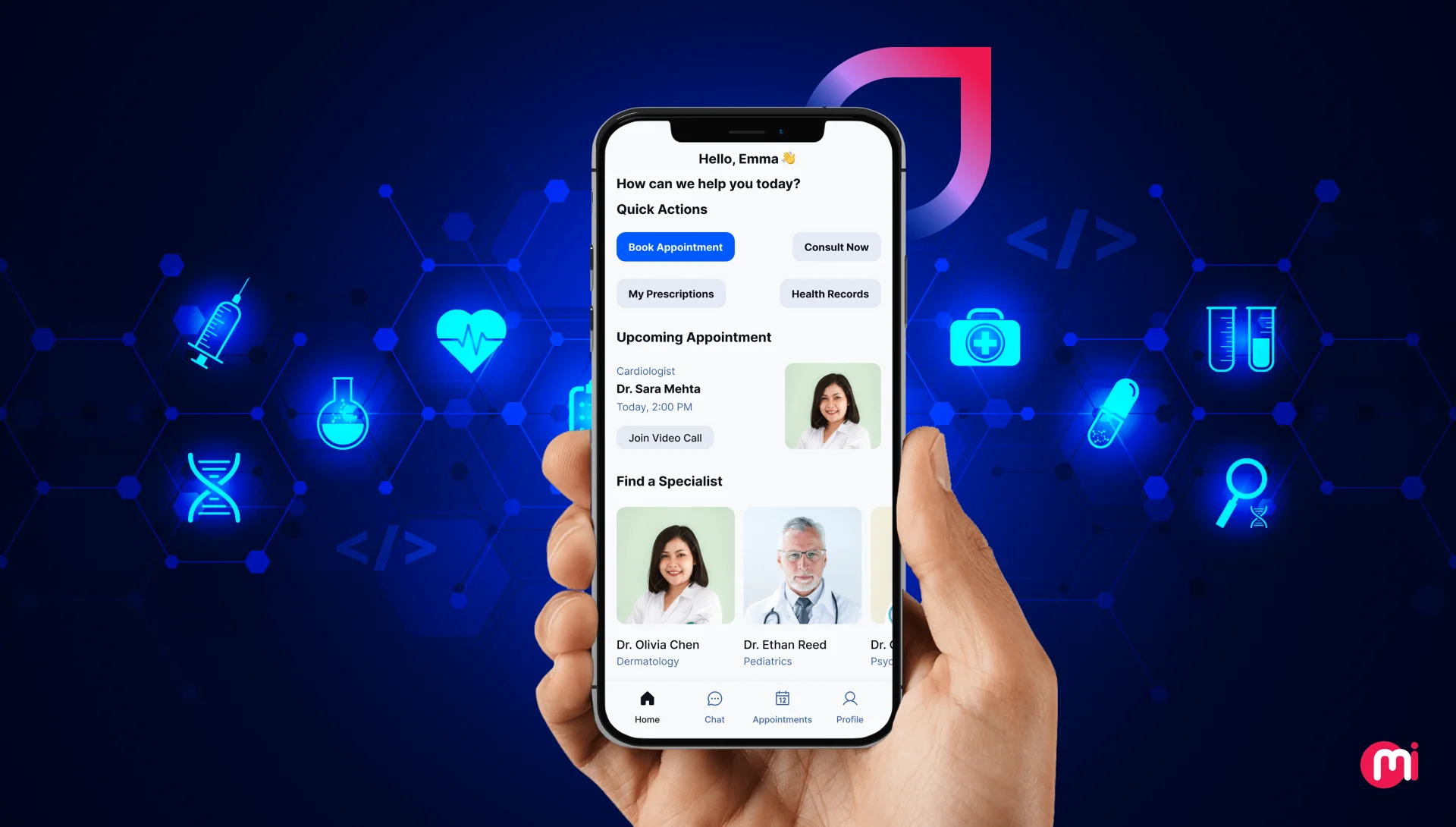
Telemedicine has revolutionized healthcare by enabling remote patient care through digital platforms. Gone are the days when healthcare was limited to clinics and hospitals. Now, telemedicine apps and appointment booking systems are streamlining outpatient services, making healthcare more accessible and convenient for everyone.
The global telehealth market is projected to exceed $680.7 billion by 2035, driven by the increasing demand for cost-effective, secure, and accessible patient engagement. Telemedicine app development is at the forefront of this growth, offering virtual consultations, remote monitoring, prescription management, and integrated chronic care platforms.
Success in healthcare app development, especially telemedicine apps, relies on seamless integration with Electronic Health Records (EHRs), compliance with regulations, and a user-friendly experience for both patients and providers. This comprehensive guide will walk you through the steps of developing a telemedicine app that delivers clinical impact and business value.
Key Takeaways:
– Telemedicine app development is a long-term investment in remote patient care.
– Success depends on seamless connectivity between patients and providers.
– Consider cloud-native architectures, FHIR-based integrations, and AI-powered analytics for long-term agility.
– Clear milestones and phased rollouts optimize development budgets without compromising quality.
– Integrating insurance, pharmacy, and diagnostics creates recurring value chains.
– Partnering with an experienced telemedicine app development company minimizes risks.
What Is a Telemedicine App?
A telemedicine app is a digital healthcare solution that allows providers to offer clinical services remotely through secure video calls, chat, and digital prescriptions. It bridges the gap between patients and doctors, providing on-demand access to medical expertise anytime, anywhere. Telemedicine app development enables healthcare organizations to build compliant tech solutions for remote consultations and monitoring, improving patient outcomes and engagement.
Key Telemedicine App Statistics:
– The global telemedicine market is expected to reach $680.7 billion by 2035, with a CAGR of 16.76%.
– In Australia, telemedicine saves patients an average of 82 minutes per year on medical appointments.
– Zoom holds a 36.2% market share in the U.S. telehealth market.
– Around 40% of U.S. physicians use telemedicine daily.
– European countries account for 35.4% of all established telemedicine services.
– The global AI in telemedicine market is projected to reach $176.94 billion by 2034, with a CAGR of 23.69%.
– 96% of telepsychiatry patients are satisfied with virtual mental healthcare.
Latest Telemedicine App Features for 2026:
Patient Panel Features:
– AI-Powered Symptom Checker & Smart Triage: Helps patients describe symptoms and routes them to the right specialist.
– Appointment Scheduling: Allows patients to schedule appointments with doctors.
– Virtual Consultation: Enables instant video/audio calls and consultation chats with specialists.
– E-Prescriptions with Medication Tracking: Auto-generates prescriptions with dosage reminders and pharmacy tie-ins.
– Personal Health Dashboard: Displays vitals, medical history, and consultation summaries for patients.
– Insurance & Payment Integration: Integrates secure payment gateways and insurance verification.
Doctor/Healthcare Provider Panel Features:
– Virtual Consultation with AI Scribe: Conducts secure consultations with AI-powered transcription.
– Integrated Patient History & EHR Access: Provides instant access to patient records and medical history.
– Digital Prescription Builder: Generates and sends prescriptions digitally.
– Smart Appointment Management Dashboard: Syncs consultation schedules and provides automated reminders.
– Earnings & Analytics Panel: Displays session earnings, performance metrics, and financial overviews for doctors.
Administrative Features:
– User & Role Management: Manages users, doctors, and staff with defined permissions.
– Compliance & Audit Monitoring: Tracks compliance with regulations in real-time.
– Analytics & Performance Dashboard: Visualizes platform activity and user growth.
– Workflow & Resource Optimization: Monitors consultations and optimizes resource allocation.
– Financial & Commission Management: Automates payment settlements and commission distribution.
Benefits of Telemedicine App Development:
For Patients:
– Easy access to healthcare specialists from anywhere.
– Streamlined prescription renewal process.
– Continuous follow-up care for better health outcomes.
– Proactive communication and monitoring for improved health engagement.
For Doctors:
– Automated appointment scheduling and patient record access.
– Cost-saving through remote consultations.
– Access to a wider patient base, including remote locations.
– Personalized treatment plans and remote patient monitoring.
How to Develop A Telemedicine App:
1. Define Functional and Compliance Requirements: Map out app features and regulatory obligations.
2. Plan a HIPAA-Compliant SDLC: Ensure compliance throughout the development process.
3. Estimate Budget, Risks, and Milestones: Outline development roadmap and budget.
4. Design UX/UI for Patients and Providers: Prioritize clear navigation and security.
5. Develop, Integrate & Test the Telemedicine Platform: Build front-end and back-end components, integrate with existing systems, and conduct QA testing.
6. Get Certified and Ensure Compliance: Verify encryption standards and obtain necessary certifications.
7. Launch, Monitor, and Scale: Launch the app, track KPIs, and continuously monitor and improve the platform.
How Much Does it Cost to Build a Telemedicine App:
– The cost can range from $40,000 to $300,000+ depending on the app’s complexity.
– Factors influencing cost include app complexity, feature set, compliance requirements, UI/UX design, tech stack, and development team location.
Top Technologies for Telemedicine App Development:
– Artificial Intelligence (AI) and Machine Learning (ML): Improve diagnosis accuracy and patient care.
– Cloud Computing: Enable secure, scalable, and globally accessible healthcare services.
– Internet of Things (IoT): Enable remote patient monitoring for proactive care.
Team Structure Required for Telemedicine App Development:
– Project Manager, Business Analyst, UI/UX Designer, Front-end Engineers, Backend Engineers, QA Engineer, DevOps Engineer, Regulatory Consultant.
Telemedicine App Development Best Practices:
– Prioritize compliance from the start.
– Use cloud-native and microservices architecture.
– Build a disaster recovery plan.
– Implement security controls and adaptive design patterns.
– Ensure compatibility with EHR systems.
Top Telemedicine App Development Trends:
– AI-Powered Diagnostics and Clinical Decision Support.
– Generative AI and Virtual Health Assistants.
– Remote Patient Monitoring with IoT Devices.
Checklist to Build Secure and Compliant Telemedicine Apps:
– Encrypt patient data end-to-end.
– Use Multi-Factor Authentication (MFA).
– Ensure compliance from day one.
– Use HIPAA-compliant cloud infrastructure.
– Implement secure communication channels.
– Track user and system activity.
– Ensure uninterrupted operations and quick data recovery.
– Continuously educate developers, testers, and admins.
How to Monetize Your Telemedicine App:
– Subscription-Based Model: Offer access through monthly or annual subscriptions.
– Commission-Based Model: Charge a commission on consultations booked through the platform.
– Freemium with Premium Add-Ons: Provide free access with premium features locked behind a paywall.
– Corporate or B2B Partnerships: Collaborate with employers or insurance companies.
– White-Label Licensing: License the app to other organizations.
– Advertising & Sponsored Content: Display ads on the app for revenue.
Examples of Top Telemedicine Apps Across the Globe:
– Teladoc Health: Offers virtual care across 175+ countries.
– Amwell: Provides on-demand video consultations with medical providers.
– Doctor on Demand: Offers 24/7 access to multi-specialty care.
– Altibbi: Delivers AI-driven diagnoses and health education in the Middle East and North Africa.
– Doxy.Me: Provides a simple and easy-to-use telemedicine platform.
Why Outsource Telemedicine App Development to MindInventory:
– ISO-certified and process-driven approach.
– Rigorous quality assurance process.
– Strong compliance and regulatory certifications.
– DevSecOps-backed software development.
– Transparent and agile delivery.
– Long-term support and maintenance alliances.
– Data privacy and ethical AI-focused development.
FAQs About Telemedicine App Development:
– Practical applications of telemedicine apps in healthcare.
– Common challenges in telemedicine app development.
– Functions required in a telemedicine app.
– Tools for building a telemedicine app.
– How to white label telemedicine solutions.
– Components of an average telemedicine app.
– Time to develop a telemedicine app.
– Benefits of building a telemedicine app.
Overall, telemedicine app development is a crucial aspect of modern healthcare, offering convenience, accessibility, and cost-effective solutions for patients and providers. By following best practices, leveraging the latest technologies, and ensuring compliance, you can build a successful and secure telemedicine app that meets the needs of today’s healthcare landscape.