
Education research doesn’t only have to be left to university researchers and think tanks. Teachers can also do it themselves, and today’s post shares concrete examples.
You might also be interested in The Best Resources For Learning About Teacher Action Research.
‘What’s Really Going on Here?”
Esmeralda Cartagena Collazo is a doctoral student and adjunct at Texas Woman’s University, specializing in the preservation of Indigenous languages:
When I think about “teacher action research,” I don’t picture a sterile process with clipboards and spreadsheets. I picture a teacher who, right in the middle of a lesson, notices something isn’t working and quietly shifts into detective mode. Teacher action research is really just a systematic way of asking “What’s really going on here?” and then thoughtfully trying out solutions to find out.
When I stepped into my 8th grade English classroom, from day one, my administrators made the rules clear: I could only speak English in the classroom, no translations. “Accommodations will take care of it,” they told me. I relied on accommodations only, but as the weeks passed, I could feel the gap widening between what my students were capable of expressing and what the system expected them to produce.
I remember thinking, If I’m not allowed to speak another language or translate for my students, what about them? That question became the heart of my action research. But before I could start, I needed to understand who my students were as learners. The district’s home-language survey didn’t give me enough, so I created my own questionnaire to learn about their literacy levels, past schooling, and experiences in their home countries. I even spoke with parents because I wanted to know the academic resources they brought with them, not just the languages they spoke.
It wasn’t easy. First, I was going against district policy, but I wanted to prove to my administrators that our languages are not a disease. Second, being the only Latino English/ language arts teacher in the school was both a privilege and a pressure I felt deeply.
That determination pushed me to look for small but meaningful ways to create space for my students’ linguistic strengths, even within the rules I’d been given. During reading discussions, I paired students and let them first talk in their home language before sharing ideas in English. In writing, I encouraged them to brainstorm, outline, or draft parts of their work in the language they knew best.
I simply observed and documented what I noticed when students were allowed to think, discuss, and draft in their home languages before transitioning to English. I kept detailed notes about engagement levels, depth of thinking, and quality of eventual English output.
At the time, I didn’t know the term “translanguaging.” For me, it was simply the right thing to do, the moral choice, to let students use what they knew to show what they understood. However, the transformation was immediate and profound. Students who had been silent suddenly became animated discussants and debaters. Then, I started collecting data more systematically, comparing writing samples from English-only assignments versus those that allowed multilingual processing, tracking participation patterns during discussions, and surveying students about their learning experiences.
The evidence was overwhelming because when students could access their full linguistic repertoire, their thinking became more sophisticated, their engagement increased dramatically, and their eventual English production improved significantly.
From my perspective as both teacher and researcher, this action research validated what :
I’d always suspected: Rigid language policies often harm the very students they claim to support. My newcomers weren’t broken English speakers who needed fixing; they were sophisticated thinkers who needed permission to access their full cognitive resources.
That cycle, identifying a question, making a plan, trying it out, gathering data, and reflecting, wasn’t just about testing a strategy. It was about proving to myself, and to my students, that the languages they bring to the classroom are an asset, not a barrier. And as I looked at the evidence, I realized something important: Action research gave me the professional freedom my curriculum and language restrictions had taken away.
And today, as a researcher, I carry those 8th grade faces with me into every conversation, every study, and every piece of advocacy, because they are the reason I will always fight for teaching that sees, hears, and values every student.

Teachers Don’t Only ‘Consume Research’
Janet K. Outlaw, Ph.D., is a faculty member at the University of South Florida. She is an elementary literacy teacher educator, dialogic pedagogies scholar, and practitioner research mentor:
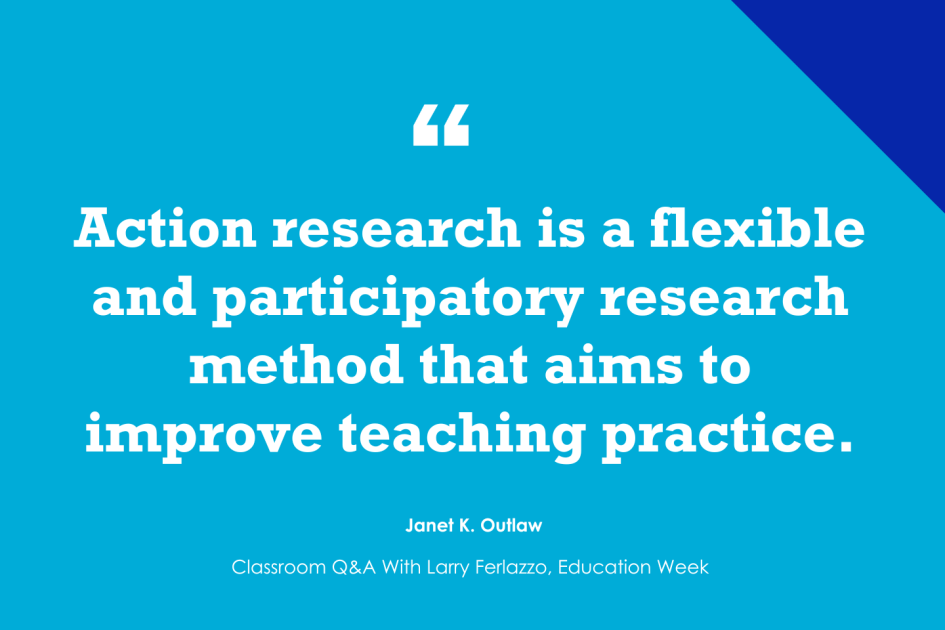
Teacher action research has been an important and empowering aspect of my teaching career. Action research is a flexible and participatory research method that aims to improve teaching practice, student learning, and/or empower classrooms and communities. I find both participating in action research myself and coaching other educators through action research to be a very rewarding experience and unique from other forms of research.
Action research can focus on improving instructional practice, like morning meetings, or small-group literacy centers. Action research can also be attuned to student needs, such as supporting multilingual students in writing or designing literacy interventions for students identified with reading difficulties.
As a teacher educator, I mentor preservice teachers through their own teacher action research in developing literacy interventions. The first step in conducting action research is to identify yourself as a researcher and the work you do as a teacher as a form of research. Reflect on all the ways you read and apply evidence-based practices in your classroom, the ways you analyze assessment data to inform instruction, and learn more about your students to develop responsive teaching practices.
I think it is important for educators to realize they not only consume research, but they also participate in research processes as a part of their professional practice. Affirming their researcher identity helps educators to fully embrace the possibilities of action research.
As a practitioner engaged in research, educators can connect and participate in professional communities to share ideas, questions, and reflections throughout their action research. This can include online communities, professional learning communities at schools, mentorship with instructional coaches, and national or international professional teaching organizations. Having a community to learn from and share your knowledge with helps with refining teaching and disseminating knowledge from your own research and practice.
The action research process involves iterative cycles of reflection, observation, and action. Action research is most impactful when you have reflected on the challenges, needs, and possibilities for what can become in your classroom, school, and local community. With a purpose for your action research, you can then engage in data collection and observation to explore how you may address the challenges and create new opportunities.
The action research process is not linear but cyclical and can be revised to continue to strengthen teaching and learning in the classroom and beyond. The realization that you as the teacher can take action for the needs of your students and communities is professionally empowering and rewarding.

‘Process, Product, and Stance’
Nancy Fichtman Dana, Ph.D., the author of 12 books and over 100 articles on or related to action research/inquiry, is a professor and distinguished teaching scholar at the University of Florida.
Diane Yendol-Hoppey, Ph.D., a professor at University of North Florida whose scholarship centers on practitioner inquiry, teacher leadership, and the design of clinically rich teacher-preparation programs, has studied teacher education for over 30 years.
Logan Rutten, Ph.D., a former middle and high school teacher-inquirer, is an assistant professor at the University of North Dakota:
If you want to continually discover creative ways to inspire your students, teacher action research (or practitioner inquiry, as we like to call it) is one of the most powerful tools you can make part of your practice. Many definitions focus on teacher action research only as a process, but teachers experience it in multiple ways: as a process, a product, and a stance, each playing an essential role in growing your professional practice.
The real magic happens when all three work together. The stance emerges from engaging deeply in the process and taking time to celebrate and share the learning captured in the product. Over time, inquiry becomes a professional habit of mind that shapes your identity and guides your practice.
The journey begins with process. Inquiry places you at the center of your own learning. Instead of relying solely on strategies handed down from outside experts, you become the investigator of your own classroom. You identify the questions that keep you wondering, the patterns you notice, and the challenges that persist despite your best efforts. These are your wonderings, grounded in your practice and your context.
From there, the process unfolds through: (1) developing your wonderings, (2) collecting meaningful data, (3) analyzing your data for patterns and insights, (4) taking informed action, and (5) sharing with others what you have learned. This cycle is not a rigid checklist but a living, evolving way of working that responds to your students’ needs and continually pushes your own thinking.
The act of working through this process naturally leads to product. Inquiry produces more than ideas; it generates concrete evidence of what is working and what is not. These products might be written reports, data displays, or presentations as artifacts that capture your learning. When you share them, your discoveries fuel individual and collective growth. Professional development shifts from something done to teachers to something done with and by teachers, increasing ownership, relevance, and impact.
This sharing also raises the likelihood that the insights born from inquiry will take root in your classroom practice, influencing not just your students but the wider learning community.
As you engage in process and create product, you can’t help but begin to embody stance which is a way of being as an educator. Stance is about seeing yourself as a learner, no matter how experienced you are. Each lesson and student interaction becomes an opportunity to learn and refine. You start noticing subtle shifts in understanding, amplifying small successes, and confronting persistent challenges with curiosity rather than frustration. This stance keeps your practice, perspective, and commitment fresh, maintaining an unwavering commitment to every learner.
Sara Montgomery, a middle school science teacher, offers a vivid example. In her professional learning community, she explored how artificial intelligence could support student learning. Facing a recurring challenge, helping students create scientific models that were both visually compelling and conceptually accurate, Sara asked, How does the use of Adobe Firefly impact student engagement with the scientific modeling process?
Her students transitioned from hand-drawn models to AI-generated images, using graphic organizers to track their model’s progression. Early on, many struggled when their prompts produced unintended images. For instance, “Create an image that shows Newton’s 2nd Law” often resulted in a picture of the “scales of justice.” Instead of dismissing the misfires, Sara turned them into opportunities for students to refine their thinking and prompts.
As the weeks unfolded, her students became more precise in their requests, producing images that captured both their mental models and a deeper understanding of Newton’s laws. Through process, Sara uncovered how generative AI could lower barriers to complex learning tasks. Her product, a presentation to colleagues, sparked conversations about teaching students to interact thoughtfully with AI tools. And her stance is evident in her ongoing inquiry into meaningful and ethical AI integration in science instruction.
Sara’s story illustrates that inquiry as a process, product, and stance are not separate boxes to check but interconnected forces that, together, shape the kind of teacher who thrives in change and leads it. When you embrace all three, inquiry stops being just a professional development activity and becomes a way of life.
Thanks to Esmeralda, Janet, Nancy, Diane, and Logan for contributing their thoughts!
Today’s post answered this question:
How would you define “teacher action research,” what are some examples of it, and how would an educator do it?
Consider contributing a question to be answered in a future post. You can send one to me at lferlazzo@epe.org. When you send it in, let me know if I can use your real name if it’s selected or if you’d prefer remaining anonymous and have a pseudonym in mind.
You can also contact me on X at @Larryferlazzo or on Bluesky at @larryferlazzo.bsky.social
Just a reminder; you can subscribe and receive updates from this blog via email. And if you missed any of the highlights from the first 13 years of this blog, you can see a categorized list here.