
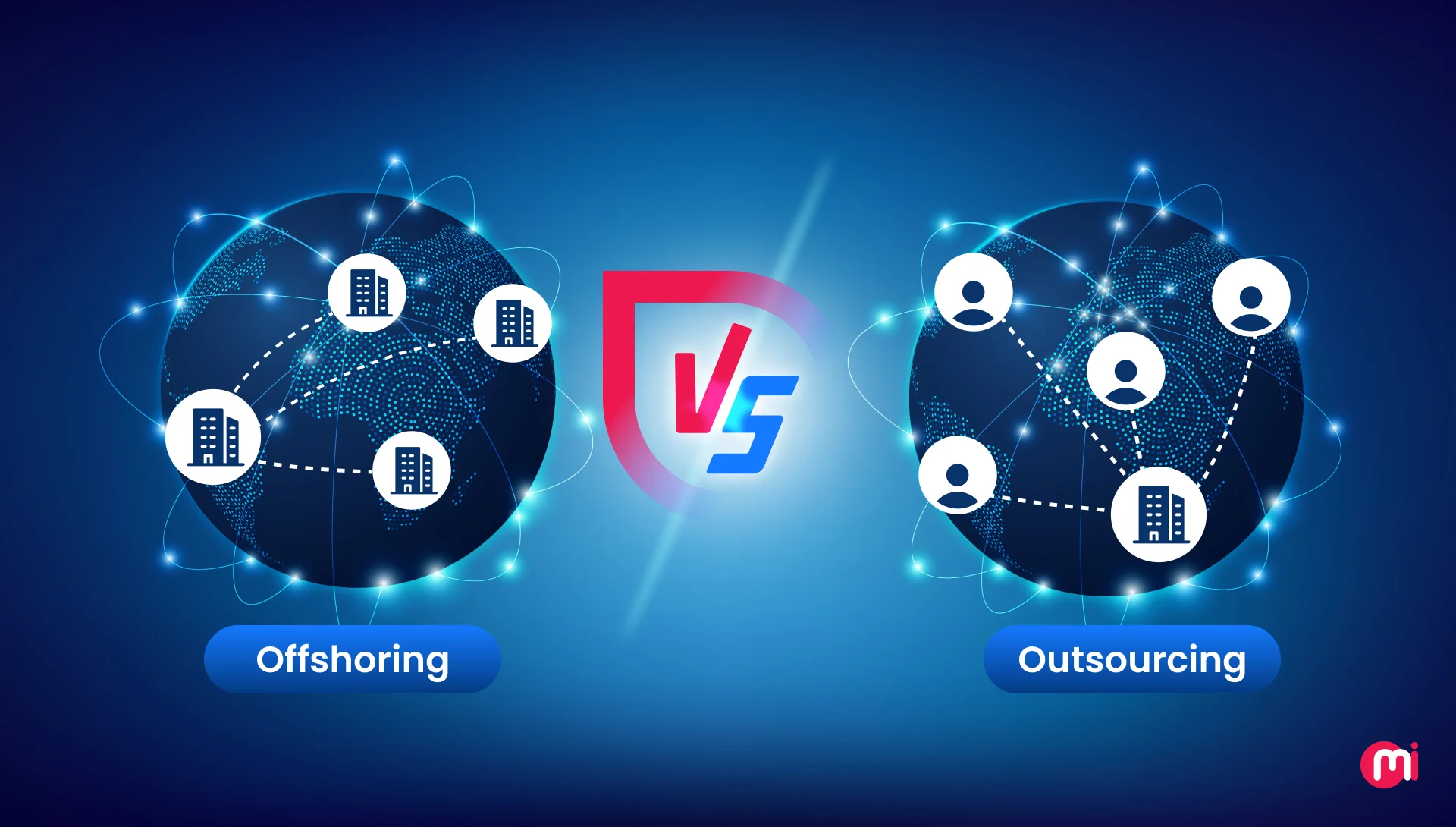
Offshoring vs. outsourcing is a topic that frequently arises when businesses are considering developing high-quality software. Both models offer cost savings and access to global talent, but they serve different purposes. Understanding the distinction between offshoring and outsourcing is crucial for meeting deadlines, maintaining quality, and scaling intelligently.
But what exactly is offshoring and outsourcing? Which model is the best fit for your team? Do they support the software development life cycle (SDLC)? Should you entrust your entire project to a third-party vendor or build a remote team that functions as an extension of your in-house team?
This article aims to unravel the difference between offshoring and outsourcing, explore their advantages and disadvantages, and examine scenarios where one model may be more suitable than the other. It will help you select the ideal model that aligns with your objectives, resources, and growth strategy.
What is Offshoring?
Offshoring is a strategic decision where a company relocates certain business operations, such as software development, cloud migration solutions, or IT support, to another country. Offshoring enables the company to maintain direct oversight and control over the teams in the new location. It is a long-term solution for businesses looking to scale efficiently while remaining closely involved in their operations.
Why Do Organizations Need Offshoring?
Businesses turn to offshoring to achieve rapid growth, access specialized talent, and scale without the high costs associated with expanding locally. Offshoring helps companies overcome common challenges such as tight deadlines, limited budgets, and workforce shortages by leveraging skilled teams globally.
Consider a scenario where a U.S.-based fintech company secures a major client and needs to introduce new features within three months. Their local developers are already occupied with critical maintenance tasks, and hiring additional in-house talent could take several months. Instead of risking missing the opportunity or delaying the timeline, they opt to offshore to Eastern Europe. The offshore team handles the development of the new features, while the local team ensures stability and seamless integration. Consequently, the company meets its deadline, maintains quality, and avoids operational strain.
In essence, offshoring empowers organizations to remain agile, control costs, and deliver faster without compromising on expertise or overburdening internal teams.
Pros of Offshoring
- Cost Savings: Offshoring often entails lower labor and operational costs, making it appealing to budget-conscious businesses.
- Access to Global Talent: Offshoring provides access to a broader pool of skilled developers and specialists with diverse technical expertise.
- Scalability: Companies can rapidly expand their teams without the lengthy hiring processes typically seen in local markets.
- Round-the-Clock Productivity: With teams spanning different time zones, development can continue 24/7, expediting delivery timelines.
- Direct Oversight: Offshoring enables businesses to retain control over workflows, processes, and team management.
Cons of Offshoring
- Time Zone Differences: Mismatched working hours may lead to delays in communication or decision-making, despite potentially boosting productivity.
- Cultural and Language Barriers: Misunderstandings due to cultural disparities or language gaps can impact collaboration.
- Onboarding and Management: Offshored teams may require additional time to align with the company’s culture, tools, and processes.
- Data Security Risks: Operating across borders may introduce complexities in managing data protection and compliance standards.
Examples of Offshoring
- Microsoft: Microsoft has offshored development and customer service operations to countries like India to optimize costs and maintain global reach.
- GitHub: GitHub and Slack have collaborated with offshore development teams during early growth phases to quickly expand engineering capacity.
What is Outsourcing?
Outsourcing is an effective business practice involving delegating specific tasks or entire projects to external vendors or third-party service providers. Companies often opt for this model when they need to reduce development costs, access specialized skills, or accelerate time-to-market without expanding their in-house team.
Why Do Organizations Need Outsourcing?
Organizations turn to outsourcing to expedite delivery, manage costs, and stay focused on their core objectives. By partnering with an external team, they gain access to specialized expertise without overwhelming internal resources or pausing critical initiatives.
For instance, a company might be in the midst of a major platform overhaul but also requires the development of a new reporting tool to meet customer demands. Instead of burdening their in-house team or recruiting new developers, they engage a trusted software development partner to outsource the secondary project. This way, the primary team remains focused on the main platform while the outsourced team handles the new build, ensuring both projects progress smoothly and meet their goals.
Ultimately, outsourcing empowers businesses to scale efficiently, meet tight deadlines, and maintain innovation momentum without straining internal capacity.
Pros of Outsourcing
- Cost Efficiency: Outsourcing often reduces labor and infrastructure costs, especially when collaborating with vendors in lower-cost regions.
- Access to Specialized Talent: Companies can swiftly bring in experts for technologies or domains they lack in-house.
- Faster Time-to-Market: External teams can work in parallel with internal staff, accelerating development cycles.
- Focus on Core Business: Outsourcing extra work allows internal teams to concentrate on strategic objectives.
- Scalability: It’s easy to scale teams up or down based on project requirements without long-term commitments.
Cons of Outsourcing
- Less Control: Working with external teams may entail limited oversight of daily workflows or decisions.
- Communication Gaps: Time zone differences and language barriers can lead to delays or misunderstandings.
- Quality Risks: Without proper vetting, the quality of deliverables may vary across vendors.
- Security Concerns: Sharing sensitive data or IP externally may heighten security and compliance risks.
- Dependency: Long-term reliance on vendors can impede internal technical growth and knowledge retention.
Examples of Outsourcing
- WhatsApp: Before being acquired by Facebook, WhatsApp outsourced development work to Eastern Europe, particularly Russia, to keep costs low while rapidly scaling the app.
- Spotify: Spotify has maintained its competitive edge in the music streaming industry by outsourcing parts of its software development to international teams, enabling agile innovation and quicker feature rollouts.
What is the Difference Between Offshoring and Outsourcing?
In the realm of software development, offshoring and outsourcing are often used interchangeably, but they serve distinct purposes and involve different approaches. Offshoring entails relocating a company’s development operations to another country to benefit from lower costs or a wider talent pool while maintaining control internally.
On the other hand, outsourcing entails engaging a third-party software development services provider to handle specific development tasks or entire projects, often with less direct control.
These two models differ in cost structure, scalability and flexibility, cultural and time zone considerations, quality and oversight, technology and infrastructure, and various other factors. Here’s a detailed breakdown of the key differences between offshoring and outsourcing:
1. Control and Ownership
Offshoring provides companies with complete authority over their dedicated software development team. Since the offshore team is part of the organization, workflows, tools, and processes can be managed directly, albeit in a different location. Conversely, outsourcing transfers much of that control to the third-party vendor. While the scope and expectations are defined by the company, the external team handles day-to-day decisions and delivery.
Therefore, in the offshoring vs. outsourcing comparison, offshoring is suitable for businesses seeking long-term team integration, while outsourcing is more effective for rapid execution with minimal management involvement.
2. Cost Structure
When comparing offshoring vs. outsourcing in terms of software development cost structure, offshoring typically involves higher initial expenses, such as infrastructure setup, recruitment, and long-term operations, although costs may decrease over time due to lower regional salaries. On the contrary, outsourcing offers a more flexible, on-demand pricing model where payment is made only for the required services, without the need to manage full-time teams or facilities.
Hence, offshoring is cost-effective for sustained development with increased control, while outsourcing is ideal for short-term or specialized needs with predictable costs.
3. Technology and Infrastructure
In the offshoring vs. outsourcing comparison, technology and infrastructure play distinct roles. Offshoring necessitates company investment in and maintenance of its infrastructure, including tools, security, and development environments. This enables customized setups and deeper integration but entails higher setup and maintenance efforts.
Conversely, outsourcing providers come equipped with their technology stacks and established infrastructure, expediting onboarding and reducing setup costs. However, this approach offers less customization and control.
If full-stack control and customized environments are needed, offshoring is the better option. For swift deployment without backend system management, outsourcing provides convenience with minimal tech responsibility.
4. Cultural and Time Zone Considerations
With offshoring, companies often function across significant time zone disparities, which can impede communication but also facilitate round-the-clock productivity. Cultural alignment may require more onboarding effort to ensure seamless collaboration.
Meanwhile, outsourcing, depending on the vendor’s location, may offer more flexibility, such as nearshore teams in similar time zones or vendors with proven cross-cultural experience.
Therefore, offshoring necessitates robust internal coordination, while outsourcing provides more choices to select culturally compatible teams or align time zones with preferred working hours.
5. Quality and Oversight
In the comparison of offshoring vs. outsourcing for quality and oversight, offshoring delivers greater control. Since the team is an integral part of the organization, processes can be managed directly, standards can be set, and output can be monitored, resulting in consistent quality over time.
Conversely, outsourcing can limit visibility into day-to-day operations. Quality heavily depends on the vendor’s practices, which may vary. Regular check-ins, SLAs, and clear communication are essential to maintain standards.
Ultimately, offshoring is suitable for companies requiring stringent oversight and long-term consistency, while outsourcing is optimal when the vendor’s expertise is trusted, and rapid execution with minimal managerial burden is needed.
6. Scalability and Flexibility
Scalability and flexibility are major differences between offshoring and outsourcing, as offshoring supports long-term growth by establishing dedicated teams that scale gradually under direct control. Although expansion may necessitate more time and planning, it ensures consistency and alignment with internal objectives.
Conversely, outsourcing is more flexible for short-term software product development projects. It allows rapid team scaling and quick access to specialized talent without the burden of recruitment or infrastructure.
In this context, offshoring favors steady, controlled scaling, while outsourcing offers on-demand agility and is ideal for fast-paced or variable project requirements.
7. Nature of Work
The nature of work is a crucial difference between outsourcing and offshoring, often influencing whether offshoring or outsourcing is a better fit. Offshoring is typically employed for long-term, core development tasks where continuity, deeper integration, and in-house oversight are crucial, such as building proprietary software or maintaining complex systems.
Conversely, outsourcing is ideal for project-based or specialized tasks, like testing, UI/UX design solutions, or feature-specific development, where speed and external expertise take precedence over full control.
In summary, the decision between offshoring and outsourcing often boils down to how central and ongoing the work is. Work strategically embedded in the business favors offshoring, while task-driven needs align with outsourcing.
8. Reliability
Offshoring often delivers greater long-term reliability, as teams are fully integrated, aligned with company goals, and trained in internal standards. Maintaining oversight supports consistent output over time.
While potentially quicker to establish, outsourcing reliability can vary depending on the vendor’s processes, talent pool, and workload. Strong contracts and communication protocols are essential for ensuring consistent performance.
Ultimately, offshoring provides greater reliability for sustained, mission-critical development, while outsourcing is an ideal choice for well-defined, short-term projects if the partner is carefully vetted.
Offshoring vs. Outsourcing – At a Glance
Here’s a comprehensive summary of the key differences between offshoring and outsourcing. This quick comparison highlights how each model impacts control, cost, scalability, and more.
| Aspect | Offshoring | Outsourcing |
|—————————–|—————————————-|—————————————|
| Control & Ownership | More control, retained ownership | Less control, vendor-managed |
| Cost Structure | Long-term savings, higher setup | Flexible pricing, low entry cost |
| Scalability | Good for structured scaling | Highly flexible, quick to scale |
| Culture & Time Zone | Higher barriers possible | Varies by vendor location |
| Quality & Oversight | Easier with dedicated teams | Vendor-dependent |
| Tech & Infrastructure | Requires setup or mature partner | Uses vendor’s existing setup |
| Nature of Work | Core, long-term projects | Specialized, short-term tasks |
| Reliability | High with alignment | Varies by vendor |Offshoring vs. Outsourcing: When to Choose What
While both models help reduce costs, expand capabilities, and support agile software development, their application and impact differ significantly. Understanding the distinction between offshoring and outsourcing is essential, as the right choice can help avoid pitfalls and build a more efficient development pipeline. Here’s how you can choose the best option:
Choose Offshoring When
- You require software consulting services, long-term, or managed IT services.
- The work involves core systems or sensitive intellectual property.
- Maintaining complete control over team workflows and output is crucial.
- You are prepared to invest in infrastructure and team integration.
- You seek better alignment with internal standards and company culture.
- Continuous collaboration and knowledge retention are priorities.
Choose Outsourcing When
- You have short-term, modular, or clearly defined project needs.
- Speed, flexibility, and cost-efficiency are more important than control.
- You need niche expertise that your in-house team lacks.
- You want to minimize setup time and operational responsibilities.
- You aim to scale quickly without long-term commitments.
- Leveraging vendor infrastructure and established workflows aligns with your requirements.
Offshoring vs. Outsourcing: Final Verdict
Offshoring and outsourcing have revolutionized the way modern software projects are developed and delivered. As global collaboration becomes ubiquitous, both models continue to offer businesses the flexibility, talent access, and scalability needed to stay competitive.
Choosing the right model is no longer solely about cost; it’s about aligning with your workflow, timeline, and growth vision. Ultimately, the software development company you select to offshore or outsource your project will make all the difference, shaping project execution, delivery, and future growth.
Searching for a Reliable Software Development Company? MindInventory is the Best Choice!
MindInventory is a trusted partner for businesses seeking to hire software developers through flexible offshoring or outsourcing models. Our team provides scalable web, mobile, and enterprise software development solutions across industries.
Whether you opt to offshore and embed dedicated developers under your full control or outsource specialized modules with flexible vendor partnerships, we tailor our services to your business needs.
We offer seamless team integration with vetted developers proficient in full-stack development, emerging technologies like AI, and industry-specific workflows. Our talent pool spans front-end, back-end, mobile, and cloud engineering, with the agility to scale up or pivot as required.
Regardless of the model chosen, we prioritize transparency, code quality, and collaboration. With robust infrastructure, a proven track record, and a security-first approach, we deliver services that align with your product vision and provide long-term value.
FAQs on Offshoring and Outsourcing Software Development
- Can you offshore without outsourcing?
Yes, you can offshore a project without outsourcing. Offshoring involves relocating work to another country while retaining it in-house, meaning your company still owns and manages the team. Outsourcing, on the other hand, involves delegating tasks to an external vendor. Therefore, offshoring without outsourcing simply entails building your own remote team abroad. - Which is better, outsourcing or offshoring?
Outsourcing offers speed, flexibility, and access to specialized skills through third-party vendors. Offshoring provides greater control, long-term scalability, and cost efficiency with dedicated teams abroad. Each model has its strengths, and the right choice depends on your project goals and resources. - Is offshoring always outsourcing?
No, offshoring is not always outsourcing. Offshoring involves relocating work to another country, but the team can remain part of your company. In contrast, outsourcing entails hiring an external vendor, which can occur locally or globally. Therefore, offshoring can be done without outsourcing if you maintain full control over the team. - What is offshoring risk?
Offshoring risk refers to the potential challenges and uncertainties businesses face when moving operations to another country. These risks include communication barriers, time zone differences, cultural misunderstandings, data security concerns, legal and regulatory compliance issues, and reduced oversight. If not managed effectively, offshoring risks can impact productivity, quality, and overall project success. - What is the difference between outsourcing and insourcing?
Outsourcing involves engaging an external company to handle specific tasks or services, often to save costs or access specialized expertise. In contrast, insourcing entails assigning those tasks to internal teams within the organization. While outsourcing relies on external talent, insourcing builds and utilizes in-house capabilities. - What is the concept of insourcing?
Insourcing is the practice of performing tasks or operations internally within the organization rather than delegating them to third-party providers. It enables companies to maintain tighter control over quality, data security, and processes and is often used for strategic functions or when aligning teams closely with business goals is critical.In conclusion, understanding the differences between offshoring and outsourcing is crucial for making informed decisions that align with your business goals, resources, and growth strategy. Whether you choose to offshore or outsource your software development project, selecting the right model can have a significant impact on project success.