
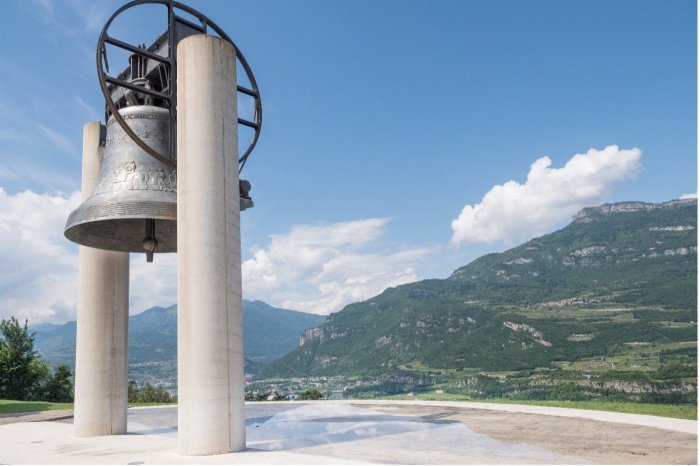
Maria Dolens, Italy’s monumental statue of peace, standing on the hill above Rovereto with the Alps in the background.
On a hill above Rovereto, in northern Italy, a massive bronze bell swings out into the evening air. As daylight fades over the Vallagarina Valley, the bell tolls one hundred times. The sound is deep and slow, rolling into the lands below across vineyards, rooftops, and old defensive walls. For locals, the daily ritual is familiar. For visitors, it is startling. Few expect a “statue of peace” to move or toll, yet Maria Dolens, the Peace Bell of Rovereto, is alive in a way that reverberates through the soul.
Italy has many memorials, but this one is different. It was cast from the cannons of nations that fought against each other in the First World War. It stands not as a triumphal figure carved in marble but as a vocal reminder of the cost of war and the possibility of peace. To understand why this monument matters in today’s world, it helps to know something about the land beneath it.
A frontline landscape turned toward peace
Rovereto sits in Trentino, a region whose gentle slopes belie a brutal past. Before being Italian in 1918, it belonged to the Austro-Hungarian Empire. The mountains surrounding it were the site of some of the harshest fighting of the First World War. Freezing winters, avalanches, hunger, trench raids, and artillery duels scarred the landscape and the communities that clung to it. The Italian and Austro-Hungarian armies fought at altitudes that killed more soldiers than enemy fire did.
This borderland history of violence shaped a generation. It also shaped Father Antonio Rossaro, a local priest who returned from the war determined that the dead of every nation should be remembered together, without distinction. He imagined a bell that could speak across borders, across political divides, and across the bitterness that still lingered in the region. A bell, he believed, could ring with a clarity that speeches could not, tolling the lesson forgotten again and again about the ugliness of war. Rossaro’s idea of a statue of peace resonates with the Isiah 2:4 passage: “…and they shall beat their swords into plowshares, and their spears into pruninghooks: nation shall not lift up sword against nation, neither shall they learn war any more.”
Forged from cannons: the birth of a “statue of peace”
Rossaro’s idea was simple but radical. He petitioned former warring countries to donate their cannons, and in 1924 the first version of the Peace Bell of Rovereto was cast from their bronze. The bell was named “Maria Dolens”: “Mary Grieving”, a reminder of the terrible cost of war. It was inaugurated the following year.
The bell did not remain static. Its sound needed improvement, and wartime alloys were unpredictable. It was recast in 1938–39, again after developing a crack in 1960, and once more in 1964–65 at the Capanni foundry. The final version, blessed by Pope Paul VI in St Peter’s Square, weighs over twenty-two tons and measures more than three meters high. Today it is among the largest swinging bells in the world.
These recastings invite an uncomfortable question: why is peace so hard to sustain? The answer lies partly in metallurgy and partly in society. What is forged from the past has to be recast when it shows signs of failure. Peace, like bronze, can fracture. What matters is the act of refounding it.
A monument that speaks
At dusk, its one hundred tolls echo through the valley, each ring a tribute to the fallen of all wars. Visitors describe the sound as a vibration rather than a noise. Something that passes through the chest more than the ears. Unlike statues that invite reflection through silence, Maria Dolens demands it through resonance.
Before reaching the bell, visitors walk along an avenue lined with flags of over one hundred nations and international organizations that have endorsed a “Memorandum of Peace” with the monument’s foundation. This approach feels ceremonial, almost processional, as if the visitor is passing through a small global gathering. The experience reinforces the idea that peace is shared work, a common road to take.
Italy’s peace identity: history, constitution and memory
It is not difficult to see why Italy embraced this bell as a national symbol. The country’s postwar Constitution declares that Italy “rejects war as an instrument of aggression” and commits to building a just international order through cooperation. Italy’s peace identity is also shaped by the legacy of St Francis of Assisi, by postwar reconstruction, and by the country’s participation in UN peacekeeping missions.
Rovereto itself was designated a “City of Peace” by the Italian Parliament in 2006. The Peace Bell sits within a network of nearby memorials, including Castel Dante, an ossuary for the fallen of the Great War. This clustering of sites forms a kind of peace landscape. A physical space that reminds visitors of what was lost and what must be guarded.
When international delegations visit the bell, including the Council of Europe on its 70th anniversary, they are engaging with a piece of Italian identity that blends cultural memory, diplomacy and civic education. The monument’s foundation runs extensive youth programmes to teach the values of peace, dialogue and responsibility. Here, peace is something taught, cultivated and handed down.
Form and function of a grieving bell
Maria Dolens functions as a powerful statue of peace in blending art, ritual and environment. The neoclassical reliefs on its sides, the panoramic view of the Alps, and the solemn rhythm of the tolling all combine to create a memorial that is both aesthetic and spiritual, demanding participation. You cannot ignore the Peace Bell’s call. Sound refuses passivity, insisting on attention.
And so, the bell raises deeper questions:
How does a society sustain peace once memory begins to fade? Can a monument like this speak meaningfully to young people who have not known the trauma it commemorates?
The foundation that oversees the bell often frames its mission around the need to educate younger generations. Peace, and a deep understanding of its opposite, is not something people inherit by default. It must be chosen, renewed and studied.
Chimes of our time
Maria Dolens does not offer easy answers. It rings the truth that weapons can be melted down, but the suffering of war still echoes among us, the conditions that lead to war require constant vigilance.
As the bell marks more than a century, its message feels sharper than ever. Europe is again confronted with war on its borders. International institutions struggle to enforce human rights. Nations debate what responsibility they have to one another, building once again the tools of destruction.
In this context, Italy’s Peace Bell is more than a local monument. Watching the bell swing against the fading sky, one senses that it is doing what monuments are meant to do: bridge past and present, grief and hope, warning and commitment. It stands on a hill that once overlooked battle lines, now transformed into a place where nations gather not to fight, but to listen.
Our choice renews every day as the Maria Dolens tolls – do we remember the cost of war, and heed its warning, or are we lulled into complacency after the chimes fade?