
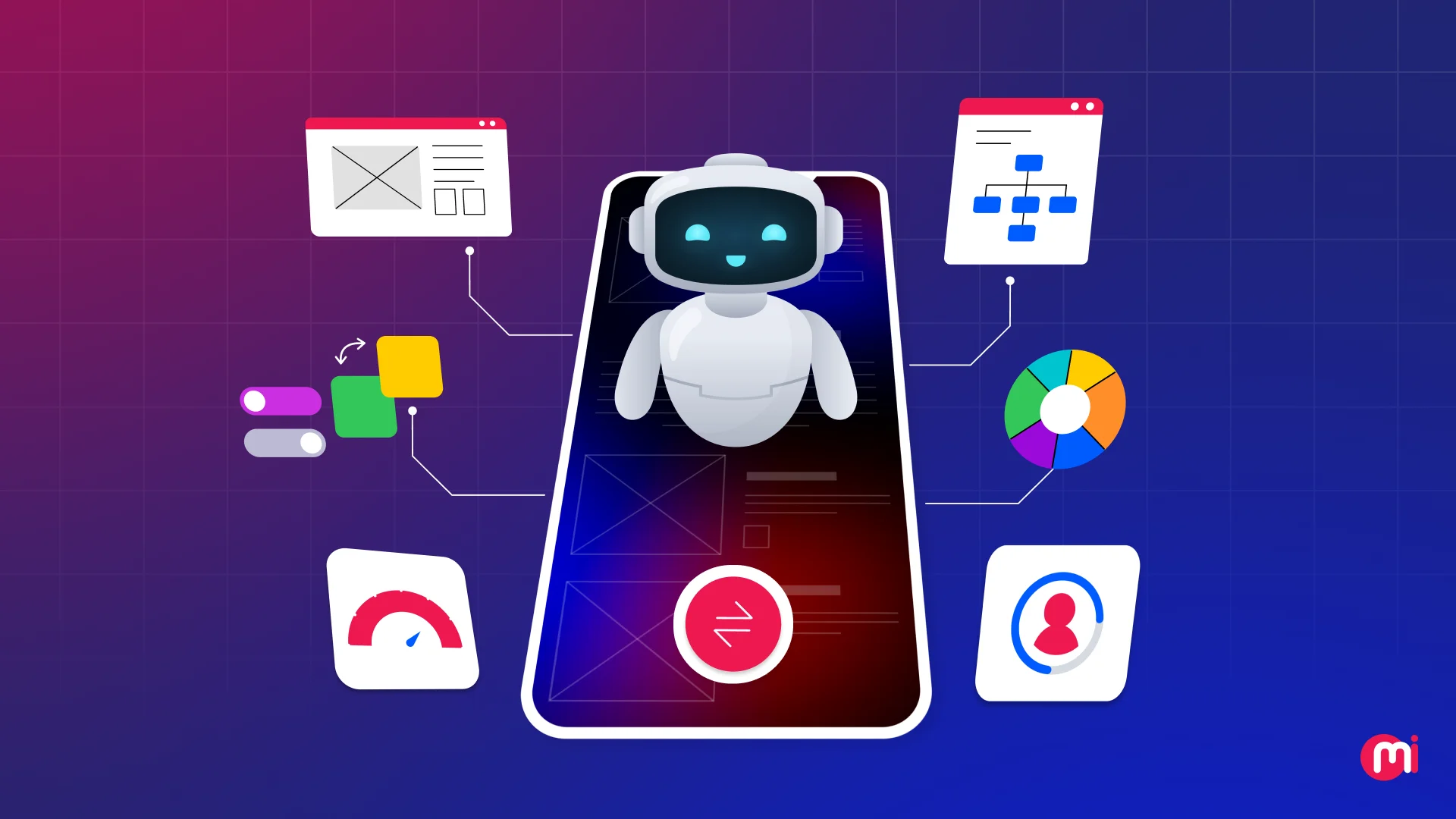
The impact of artificial intelligence (AI) on UI UX design efficiency is evident in a survey conducted by ResearchGate, where 74% of respondents acknowledged its influence. AI has transcended mere automation and experimentation in UI/UX design, evolving into a practical tool for understanding users, expediting design workflows, and creating personalized experiences.
AI plays a pivotal role in various aspects of UI UX design, such as generating layouts and UI components, customizing user experiences, providing predictive analytics, and enhancing user testing. By leveraging AI, designers can make more informed decisions based on real user behavior, ensuring a faster UI UX design process. This allows designers to focus on creativity, empathy, and strategic thinking, while AI handles data-heavy and repetitive design tasks.
The utilization of AI in UI UX design spans across several key use cases, including user research, rapid prototyping, personalization, creating adaptive interfaces, and more. AI aids in speeding up the UI UX design lifecycle, from initial discovery to post-launch enhancements, ensuring a seamless design process.
AI tools and plugins have revolutionized modern UI/UX design, with popular options like UX Pilot, Claude, Fronty, Uizard, Galileo AI, Magician (Figma Plugin), and others. These tools automate wireframing, generate UI components, and assist in design-to-code workflows, streamlining the design process and optimizing workflow efficiency.
The future of AI in UI UX design is poised for hyper-personalization, predictive UI, spatial and immersive computing, generative AI in design workflows, among other trends. As AI continues to evolve, it will drive UI UX design towards more adaptive, data-driven, and continuously optimized experiences.
In conclusion, AI is reshaping UI/UX design by enhancing adaptability, data-driven decision-making, and continuous optimization. Designers can leverage AI to understand users better, prototype faster, automate repetitive tasks, and deliver personalized experiences at scale. With the right AI integration, businesses can create products that not only look good but also perform exceptionally, exceeding user expectations.