
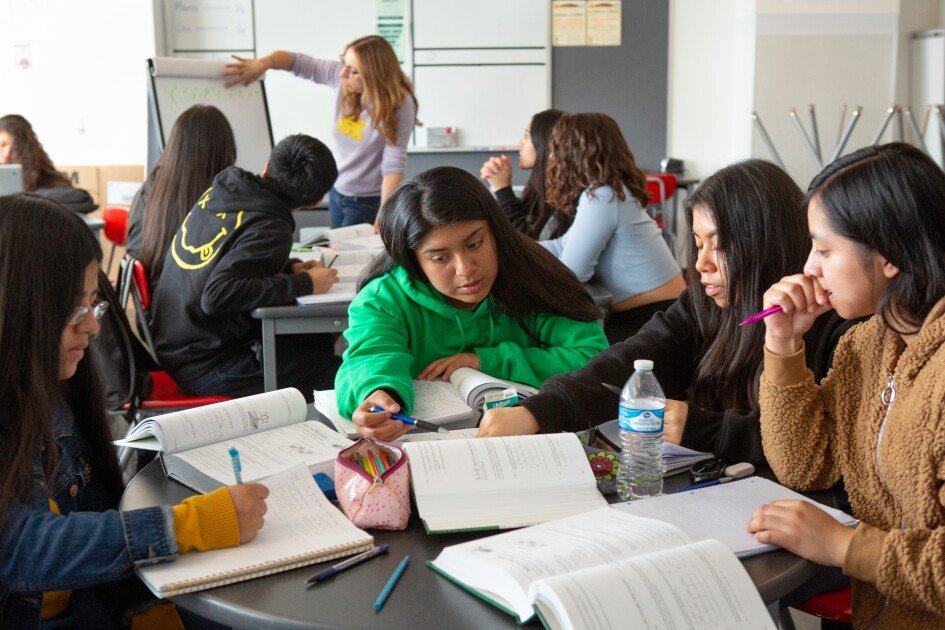
As educators work to make gifted and talented education more equitable, one researcher is drawing attention to a student group that is particularly underrepresented in programs for advanced learners: Hispanic English learners.
While only a small subset of students—6% of public school students in the 2022-23 school year, according to the National Association for Gifted Children—are enrolled in gifted programs, English learners are 8 times less likely to be identified to participate in those programs relative to their share of the national student population.
White students are 47% more likely to be selected for gifted programs than Hispanic students. Black students and students with disabilities are also underrepresented.
Apolonio Trejo, an assistant professor of bilingual education at Our Lady of the Lake University in San Antonio, has been researching the underrepresentation of Hispanic English learners in gifted and talented programs since his Ph.D. dissertation. He planned to present his findings during the ISTELive 25 + ASCD Annual Conference 25 in San Antonio June 29 to July 2.
During an interview ahead of the conference, Trejo shared his insights on gifted programs in the Lone Star State, professional development for teachers who work with advanced learners, and how teachers can flag unconscious biases about Hispanic English learners.
The interview has been edited for length and clarity.
What are some gifted and talented characteristics English learners may have?
There are many characteristics that students bring that we don’t see. For instance, there are cognitive characteristics, and one of them is that [students who are learning two languages] have an ability to learn faster than most students.
One of the things that I focus a lot on is their ability to code-switch and to translanguage. When you start translanguaging, you have learned to manipulate both languages, Spanish and English, and not all students can do that.
That’s when you start getting all this Spanglish, where students make up their own words, because they’re using their entire brain. Not all gifted or high-achievers can do that.
What’s the state of professional development for gifted and talented teachers?
In the state of Texas, a teacher needs to complete at least 30 hours of fundamental gifted and talented professional development.
Then you take a refresher course, a six-hour update of what you learned. This [refresher course] is something that needs to be done at least every year—the six hours help, but it needs to be in-depth.
In my research, every single teacher who I interviewed said, “I do not understand what I’m doing when it comes to gifted students,” whether in Spanish or English. A lot of them lack professional development.
How can the identification process for gifted students miss certain students?
Let’s say that the student doesn’t do well or performs at a high level on our [gifted and talented identification] test. The parents have the right to go outside the school district and get an IQ test.
That right there becomes discriminatory. When I was at the school district, parents were paying—one of them told me—almost $1,200 to get an IQ test.
We needed to stop accepting those tests because it’s unfair and not loyal to our [gifted and talented] program. We were not loyal to protocol. There was no fidelity, and that’s what I talked about in my dissertation.
That fidelity needs to be present. You cannot change and break those little protocols because of one student. If you do it for one student, you have to do it for every single one of them, because that’s the ethical thing to do.
Do you have any tips for teachers to check themselves for unconscious biases?
It’s hard because that’s what we call an unconscious bias. We don’t realize what we’re saying at times, and it happens more often than you think.
I always encourage all the teachers who I worked with in the past 24 years to treat your students as if that was your child. Would you like someone to say that about your child before you even say it?
If you’re going to be teaching gifted students, and you have African Americans, Hispanics, white students, and Asians together in one classroom, it’s a must that those students need to work together. After all, they’re at different levels.
Spend time getting to know their culture, spend time getting to know the community, and get to know the students so that we avoid those comments.
How can teachers engage families when it comes to gifted programs?
In 1974, a [federal] law said that every single document that goes home needs to be in a language that a parent can understand.
I told my gifted teachers, “Hey, we need to do this in Spanish.” [Teachers] had sessions that were in English for whoever wanted to nominate [their child] for the gifted programs. And they’re like, “Well, none of us speaks Spanish.”
Guess who was there that night? I was, and I was translating everything to the Spanish speakers because they needed to get the same chance.
When you don’t speak the language, you’re excluding them. If you have students [who speak] a different language, and you provide everything in English to the parents and the students—I actually feel that that’s educational discrimination.
The parent needs to understand what giftedness is. One of the things that I know [about parents] who are from Mexico and other Latin American countries is that parents in that culture see the teacher as the expert. We need to change that so that the parent can question [a teacher].