
The realm of digital twin technology is rapidly expanding, with the market projected to reach a staggering $240.3 billion by 2035, boasting a CAGR of 30.54%. This growth is not merely a trend; it signifies substantial investments in infrastructure, industrial transformation, and enterprise software budgets all moving cohesively towards a common goal.
Digital twin technology is transitioning from experimental phases to actual business deployment. Various industries such as manufacturing, healthcare, smart infrastructure, and energy are leveraging digital twin services to simulate operations, monitor assets in real-time, and enhance operational decision-making.
However, the development of a dependable digital twin system goes beyond just collecting IoT data. It necessitates the utilization of the appropriate platform or engine capable of modeling assets, processing live data streams, conducting simulations, and visualizing outcomes efficiently at scale.
The digital twin landscape is diverse, with platforms specializing in industrial simulation, 3D environments, IoT integration, or AI-driven predictive modeling. Selecting the wrong platform can lead to costly architecture revisions down the line.
This guide delves into the top digital twin platforms and engines available today, encompassing the tools utilized to construct digital replicas for factories, buildings, supply chains, and smart cities.
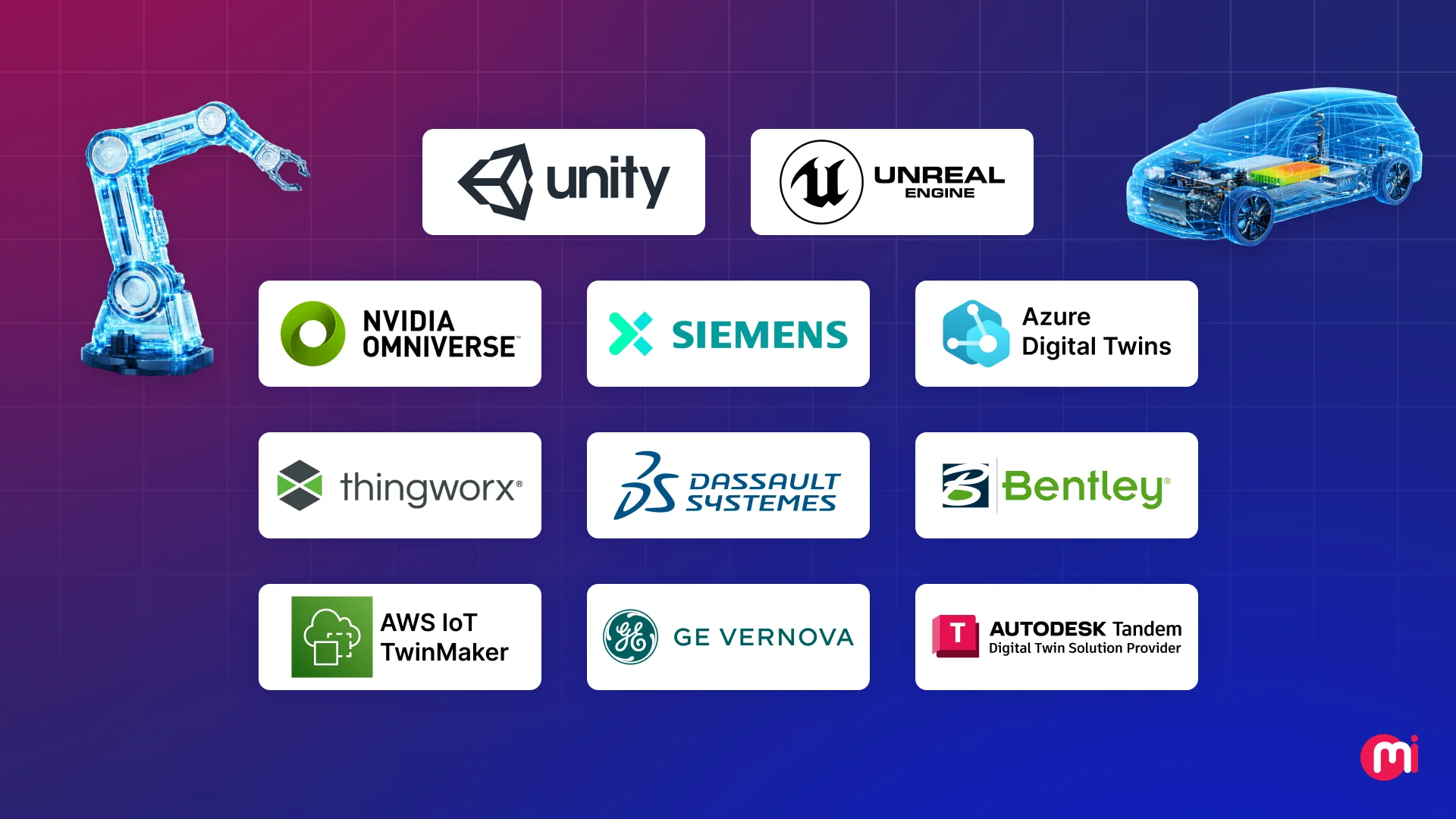
Enterprise digital twin platforms facilitate the virtual replication of physical assets, processes, and systems for simulation, prediction, and optimization. Leading digital twin platforms in 2026 include Microsoft Azure Digital Twins, Siemens Xcelerator, GE Vernova, PTC ThingWorx, and others, each catering to diverse enterprise requirements. Noteworthy digital twin development engines comprise Unity, Unreal Engine, and NVIDIA Omniverse. The choice of the right platform is contingent on industry, existing tech stack, simulation complexity, and scaling requirements. Cloud-native platforms offer expedited deployment and scalability, while on-premises solutions afford greater control over sensitive data.
Digital Twin Platform vs. Digital Twin Engine: What’s the Actual Difference?
A digital twin platform functions as an end-to-end environment encompassing data ingestion, visualization, analytics, and lifecycle management. Conversely, a digital twin engine excels in a specific layer such as simulation, physics modeling, or real-time 3D rendering. Azure Digital Twins, Siemens Xcelerator, and PTC ThingWorx are examples of digital twin platforms, while NVIDIA Omniverse, Unreal Engine, and Unity are categorized as digital twin development engines.
The article goes on to detail the best digital twin development engines, the best digital twin platforms for enterprises in 2026, and provides key takeaways for selecting the ideal digital twin platform for a project.
In conclusion, the article emphasizes the importance of aligning the chosen digital twin platform with the use case, existing data, and operational workflows. It stresses the significance of defining the twin’s objectives, data dependencies, and the intended users before making a selection. The piece also addresses frequently asked questions about digital twin platforms, providing comprehensive insights into their functionality, application, and deployment timelines.