
Key Points to Remember
- AI agents are autonomous software powered by AI that analyze, make decisions, and learn to achieve specific goals on behalf of users.
- AI agents in the healthcare sector interpret medical information, make decisions, and take actions to enhance patient outcomes, support providers, and optimize operations.
- By utilizing AI agents in healthcare, organizations can achieve faster, more accurate diagnoses, personalized treatment plans, enhanced patient engagement, and improved outcomes.
- Healthcare institutions can utilize AI agents to support diagnosis, personalized treatment plans, drug discovery, workflow automation, and fraud detection.
- Sully AI, Innovaccer, and Notable are examples of AI agents being effectively used in the healthcare industry.
Healthcare systems are facing unprecedented challenges, with rising costs, clinician burnout, and fragmented patient data affecting both efficiency and care quality.
This is where the demand for AI in healthcare, particularly AI Agents, is increasing. AI agent solutions are helping healthcare institutions transform their operations and deliver improved patient care.
As the Agentic AI can secure the healthcare market size of $4.96 billion by 2030 at a CAGR of 45.56% from 2025 to 2030, AI Agents, as a component of it, can offer significant benefits to the healthcare industry.
So, how can you leverage AI Agents in Healthcare software trends in your operations? This article provides comprehensive information on AI Agents in healthcare, covering types, benefits, use cases, and real-world examples.
Let’s dive in!
Understanding AI Agents in Healthcare
AI agents are software systems that can independently perform tasks, make decisions, and interact with data or users, often without continuous human intervention.
AI agents in healthcare are intelligent systems that interpret medical information, make decisions, and take actions to enhance targeted healthcare processes, leading to improved patient outcomes, supporting providers, and optimizing administrative operations.
Also Read: How Autonomous AI Agents Are Shaping Our Future
Types of AI Agents In Healthcare
The main types of AI agents in healthcare include rule-based agents, ML-based pattern recognition agents, contextual AI agents, conversational agents, analytical agents, and multi-agent systems.
Let’s explore these different types of AI agents in healthcare:
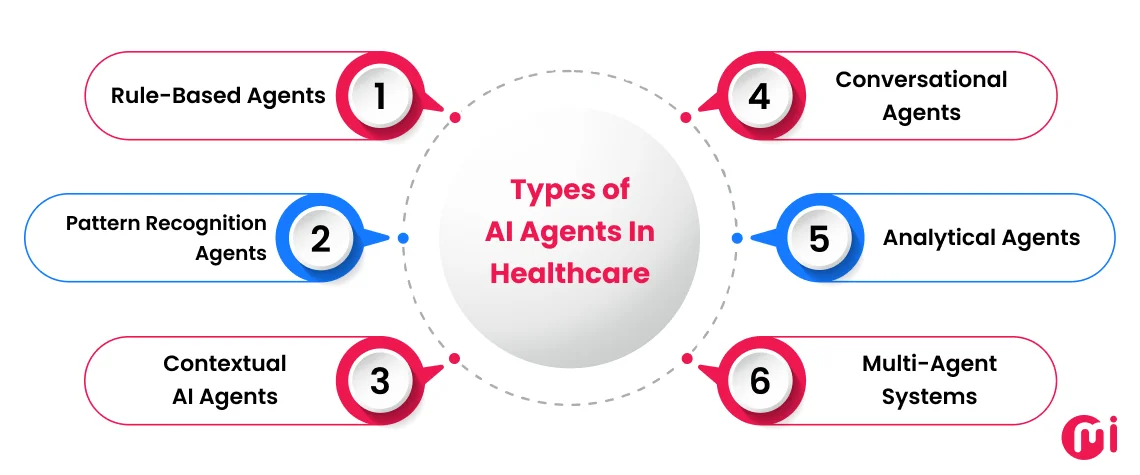
1. Rule-Based Agents
These agents are designed to follow predefined rules to perform specific tasks. Healthcare organizations can use rule-based agents to handle simple, repetitive tasks like alerts, reminders, or answering FAQs.
2. Pattern Recognition Agents (ML-Based)
These are ML-powered agents that can identify trends, correlations, and anomalies in large datasets. Healthcare organizations can use pattern recognition agents to detect early signs of disease, monitor patient vitals, or flag unusual billing patterns.
3. Contextual AI Agents
These AI agents are capable of making decisions based on a broader understanding of patient data and operational context. Healthcare institutes can leverage contextual AI agents to suggest treatment plans or workflow adjustments, considering multiple factors simultaneously.
4. Conversational Agents
These AI agents are as simple as natural language interfaces, like chatbots or voice assistants, that patients and staff can interact with. But the difference is, they provide experience as if they are communicating with a professional to resolve their queries. Healthcare institutes can integrate conversational agents to handle appointment scheduling, patient queries, follow-ups, and basic triage.
5. Analytical Agents
Unlike simple predictive analytics dashboards, analytical agents process and analyze complex datasets to generate insights and predictions. When we say analytical agents, healthcare institutes can leverage them to support clinical decisions, population health analysis, and resource planning.
6. Multi-Agent Systems
Call it a multi-agent system or an agentic AI system; it enables more than two AI agents to collaborate to solve complex problems to achieve common goals. Healthcare organizations can leverage multi-agent systems to combine imaging analysis, patient data, and workflow automation to deliver comprehensive care solutions.
Read about AI agents vs Agentic AI for better clarity
Reasons Why Healthcare Organizations Require AI Agents
Most healthcare organizations adopt AI agents to address operational challenges, boost productivity, enhance clinical decision-making accuracy, deliver proactive patient experiences, and unlock the value of siloed data.
To Address Operational Challenges and Rising Costs
Hospital staff are often burdened with administrative tasks, including manual data entry, repetitive workflows, and seeking approvals. By using AI agents, healthcare providers can automate routine tasks like claims processing, scheduling, and reporting, freeing up staff to focus on patient care while reducing operational costs and time.
To Enhance Diagnostic Accuracy for Doctors
AI agents act as digital assistants for doctors, assisting them in analyzing patient histories, lab data, and imaging results to provide critical insights quickly. This reduces cognitive load and burnout, enabling medical teams to make confident, evidence-based decisions, leading to improved diagnostic accuracy.
To Provide Personalized Patient Experiences
Patients expect healthcare apps to offer the same convenience as consumer apps. AI agents can provide personalized reminders, chat-based symptom checkers, and predictive follow-ups, enhancing patient engagement and adherence to treatment plans.
Healthcare providers benefit from improved adherence, clinical forecasting, and value-based care initiatives.
To Utilize Siloed Data Effectively
Healthcare data is often stored in various locations, making decision-making challenging. AI agents help unify and interpret this data in real-time, creating a single source of truth that drives population health insights, clinical forecasting, and value-based care initiatives.
To Navigate Ethical and Regulatory Hurdles
The healthcare industry is highly regulated, requiring AI agents to navigate complex regulatory and ethical landscapes. AI agents can automate compliance with regulations like HIPAA, HITECH, protecting patient data.
AI agents also enforce explainable AI, ensuring accountability and building trust with clinicians and patients.
Also Read: AI Agents for Business: Definition, Benefits, and More
Advantages of AI Agents in Healthcare
When healthcare providers integrate AI agents into their processes, they benefit from advanced diagnostic support, automated administrative workflows, personalized patient experiences, regulatory alignment, cost reduction in patient care, and more.
Let’s explore the key benefits of adopting AI agents in healthcare processes:
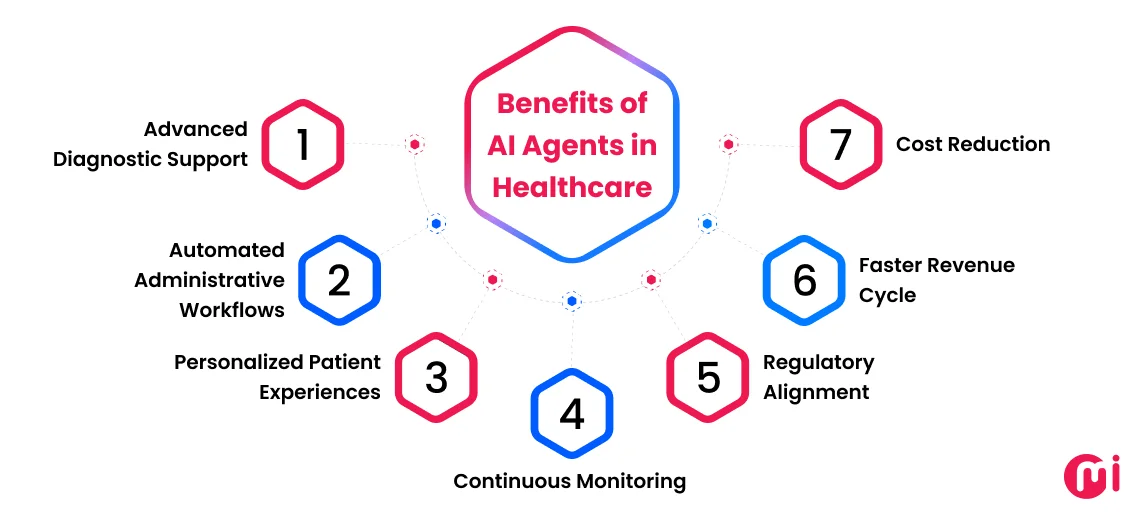
1. Advanced Diagnostic Support
An AI agent connected with radiology, laboratory, and EHR/EMR systems can access comprehensive patient data. These AI agents can analyze medical images, pathology, and patient data with high accuracy, detecting patterns that human eyes might miss. This leads to faster and more accurate diagnoses.
2. Automated Administrative Workflows
AI agents benefit hospital administration by automating tasks such as patient intake, appointment scheduling, referrals, and billing, significantly reducing administrative costs and processing time.
3. Personalized Patient Experiences
AI agents leverage patient data to recommend personalized treatment plans and predict responses to therapies. This leads to improved patient outcomes and engagement.
4. Continuous Monitoring
AI agents integrated with medical devices can track vital signs and alert care teams about potential health risks, enabling early intervention and contributing to chronic disease management.
5. Regulatory Alignment
AI agents have access to healthcare data systems, monitoring data access patterns and ensuring compliance with regulations like HIPAA and GDPR. They help maintain audit trails, secure patient data, and ensure workflows align with healthcare regulations.
6. Faster Revenue Cycle
AI agents automate claim processing, verification, and billing, reducing errors and accelerating revenue collection.
7. Cost Reduction
By combining automation, predictive analytics, and resource utilization, AI agents reduce administrative and operational costs, improving care quality while maintaining financial sustainability.
Also Read: AI Agents for Enterprises: Practical Use Cases, Examples, and Implementation Strategies
Top Use Cases of AI Agents in Healthcare
AI agents can empower processes like diagnostic support, clinical documentation, personalized treatment plans, remote patient monitoring, revenue cycle management, and more in the healthcare industry.
Let’s explore the top AI agents in healthcare applications for promising outcomes:
1. Diagnostic Support
AI agents analyze patient data to detect patterns, surface likely diagnoses, and reduce diagnostic errors, leading to faster and accurate diagnoses.
2. Clinical Documentation With Ambient Scribe
AI agents can transcribe patient-clinician conversations, reducing documentation time and enhancing physician-patient interactions.
3. Personalized Treatment Plans
AI agents analyze patient characteristics to recommend tailored treatment plans, improving treatment efficacy and reducing adverse events.
4. Remote Patient Monitoring
AI agents track real-time health data to predict deterioration, enabling proactive care for chronic diseases and post-discharge patients.
5. Revenue Cycle Management & Claim Management
AI agents automate billing workflows, verify payers’ rules, and minimize claim denials, improving revenue cycle management.
6. Medical Coding & Billing Support
AI agents suggest accurate medical codes and improve documentation for optimal reimbursement, reducing coding errors.
7. Fraud Detection & Compliance Monitoring
AI agents analyze billing patterns and provider behavior to detect fraud, waste, abuse, and compliance violations, reducing financial losses and ensuring regulatory compliance.
8. Virtual Health Assistants & Patient Engagement
AI agents engage patients through chat or voice interfaces, providing support for scheduling, reminders, and self-care, improving patient satisfaction and reducing call center volume.
9. Chronic Disease Management
AI agents monitor ongoing health data and coordinate care across providers, improving outcomes for chronic disease patients and reducing healthcare costs.
10. Operational Optimization Applications
AI agents optimize hospital operations by forecasting demand, managing resources, and identifying inefficiencies, leading to improved capacity utilization and cost savings.
| Category | AI Agent Use Case |
| Diagnostic Support | Analyzes patient data to detect patterns, surface likely diagnoses, and reduce diagnostic errors. |
| Clinical Documentation | Transcribes consultations, auto-fills EHRs, and cuts physician documentation time. |
| Personalized Treatment Plans | Uses genomics and patient data to recommend tailored, evidence-based therapies. |
| Remote Patient Monitoring | Tracks real-time health data to predict deterioration and prevent readmissions. |
| Revenue & Claim Management | Automates billing workflows, verifies payers’ rules, and minimizes claim denials. |
See also Data Driven Design in UX: A Comprehensive Analysis
|