
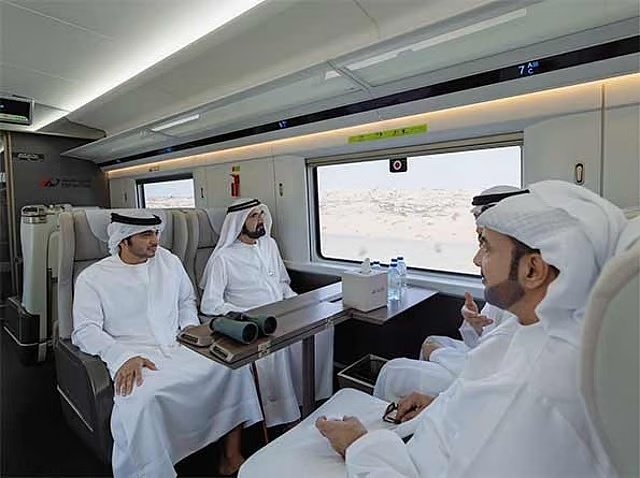
“I’m proud of our national projects. I’m proud of the Etihad Rail team led by Sheikh Theyab bin Mohamed bin Zayed,” Sheikh Mohammed wrote on X.
His Highness Sheikh Mohammed bin Rashid Al Maktoum, Vice President, Prime Minister of the UAE, and Ruler of Dubai, embarked on a test ride aboard the Etihad Rail passenger train from Dubai to Fujairah, marking a major milestone in the development of the UAE’s first national rail network. Scheduled to open to the public in 2026, the passenger service will connect 11 cities and regions across the country, stretching from Al Sila in the west to Fujairah in the east, with trains capable of reaching speeds of 200 km/h.
Sheikh Mohammed praised the progress of the ambitious project in a post on his official X account, commending the leadership of Sheikh Theyab bin Mohamed bin Zayed and the dedicated efforts of the Etihad Rail team. He expressed pride in the UAE’s commitment to building future-ready infrastructure, describing the project as a symbol of national ambition and resilience.
Mohammed bin Rashid boards Etihad Rail passenger train for journey between Dubai and Fujairah ahead of commercial launch in 2026. pic.twitter.com/p4GTZPetp9
— Dubai Media Office (@DXBMediaOffice) August 2, 2025
Once operational, the network is expected to carry 36 million passengers annually by 2030, dramatically reducing travel times—such as just 57 minutes between Abu Dhabi and Dubai—and enhancing the country’s urban connectivity and sustainability. The project also promises to strengthen domestic tourism, with forecasts suggesting up to Dh24 billion in tourism revenue over 50 years.
As part of the Dh50 billion National Railways Programme, the combined passenger and freight network is projected to generate Dh200 billion in economic benefits, including reduced transport and road maintenance costs, improved urban planning, and greater road safety. Environmentally, each freight train will replace 300 trucks on the road, contributing to a projected 21% annual cut in land transport emissions by 2050—equivalent to 8.2 million tonnes of CO₂ saved per year.