
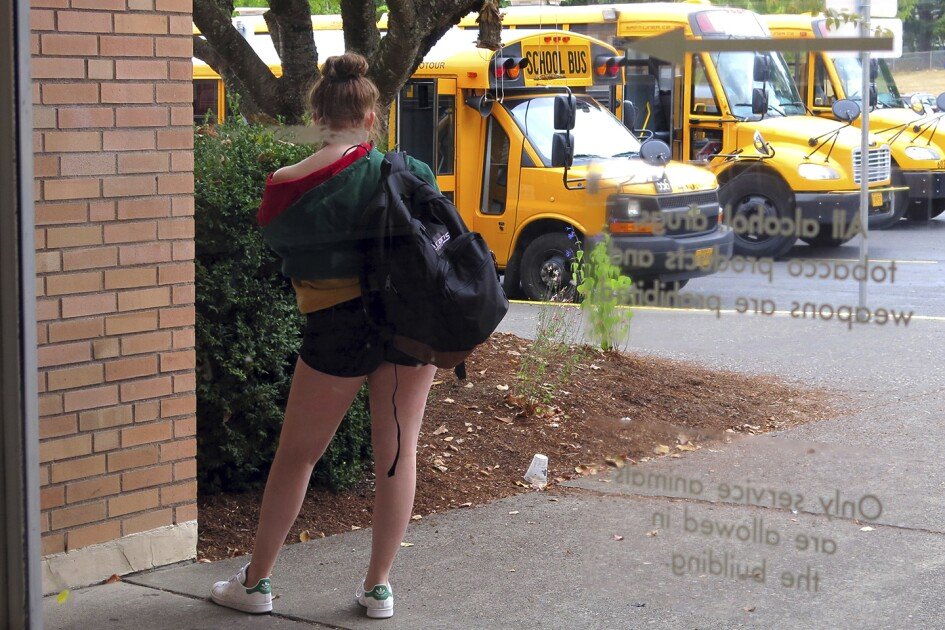
The student dress code debate is complicated and long-standing, but is it possible to adapt standard policies to create an inclusive and non-discriminatory school environment? A new brief has fresh ideas for schools to consider.
Late last month, the Leadership Conference Education Fund—along with five other advocacy and research groups—released the policy paper, “Nondiscrimination in Dress and Grooming Codes,” with nine suggestions for schools. For example, the brief argues that educators should conduct a climate survey to gauge how students feel about dress codes, ensure that noncompliance by a student does not result in loss of instructional time, and eliminate subjective language from school discipline policies.
Around 60% of school dress codes have rules that deal with student body measurement and clothing, according to a 2022 Government Accountability Office (GAO) report. Black students and girls of all races are disproportionately affected by the rules. For example, Black girls and boys might be disciplined for wearing natural hairstyles, and girls are affected by dress codes that ban wearing spaghetti straps, short skirts, and leggings as pants.
According to the GAO report, 44% of dress codes include informal removal policies, such as removing a student from class without documenting it as a suspension. These types of policies can also make some teachers, specifically male teachers, uncomfortable if they have to enforce a dress code on a female student.
In an interview with Education Week, Adaku Onyeka-Crawford, senior staff attorney and director for the Opportunity to Learn program at Advancement Project, who worked on the brief, discussed how dress codes can be discriminatory and shared potential ways to begin to change these policies.
This interview has been edited for length and clarity.
What are the big takeaways from the dress code brief?
Dress and grooming code enforcement [is] one of the more insidious ways that students are policed and pushed out of schools, [including] by targeting hairstyles that are natural for Black and brown students or have some kind of cultural significance for Native American students.
A lot of times, these policies punish students for having hair and grooming styles that suit their cultural identities.
It’s something that happens at a very young age and follows [students] throughout school, and communicates to people along race and gender lines that they are not welcome in this environment unless they strive to stereotypical notions of how someone should present in school—and that is usually centering whiteness and white supremacy.
I think the largest takeaway is that we should be allowing students to come to school in ways that they feel powerful or affirmed, and we shouldn’t be punishing and policing students in this way. If they’re in the school building, they’re there to learn, and so let’s try to teach them in the ways that they feel ready to learn.
What are some common consequences of dress code enforcement?
I think some of the most punitive policies we see are people getting pulled out of class, even suspended, for an outfit that they’re wearing or for the way their hair grows naturally out of their head.
All that does is teach students that how they naturally show up is not welcome. Nobody should miss class because they’re wearing a skirt or because their hair is styled a certain way.
I think another thing that we see is that sometimes, … if girls are being sexually harassed, they get blamed for it, like, “Well, what do you expect? Look at what you’re wearing.”
That sends a wrong message to girls. We should be teaching students to respect each other regardless of what they’re wearing, regardless of [how] they’re showing up, and to value other people’s identities and their presence in class.
When we talk about school climate, does it only affect students?
I think it can affect teachers. Sometimes, what we hear from teachers is that they don’t want to enforce dress codes, but usually, there’s an administrator or some other school official who requires them to police students in this way.
It affects students, but also distracts teachers from being able to do their job, which is to educate students. That’s another reason why this restrictive enforcement on dress codes isn’t conducive to the learning environment, and schools should embrace a more open dress code that acknowledges and values students’ cultural and racial identities.
What students are most affected by dress codes?
Black students are targeted for dress code enforcement—boys and girls, although in different ways. We’ve seen stories about boys with dreads or locs being punished because there are dress code policies that say that boys can’t have their hair a certain length.
We’ve also seen policies that limit the height of hair, which disproportionately is affecting Black students who have natural hairstyles. Policies that target length of hair for boys also affect Native American students [when] there’s cultural significance to their hair and not cutting it. Then, we also see policies where students aren’t allowed to have extensions, and that targets Black girls who tend to have braids or other protective styles.
Also, [some dress codes] target certain clothes that are worn by Black students like durags, [or have] policies about being able to wear headgear, which might affect students based on religious customs.
What is ‘subjective language’ in school policies when it comes to dress codes?
The policies around the length of skirts, and subjective things like, “[clothes] should be neat and clean.” That is subjective—how [do] we determine what neatness and cleanness looks like?
We’ve even seen policies that say certain clothes can’t be trendy or faddish. [But] when you think about culture, Black culture is always on the leading edge. So when we see these subjective policies, that is a way that racial bias can sneak in and typically where we see models of white supremacy being censored and thinking that whiteness is the norm—and anything that falls out of that norm gets punished.
How can schools investigate if a dress code policy or implementation is resulting in discrimination?
We all have biases—it’s become a four-letter word—but it’s about correcting for those biases. That’s why making sure that subjective language isn’t so critical.
[Schools] should be collecting information on the number of students who are put in in-school suspension or out-of-school suspension or expelled, and then also the reasons for why. They should be collecting this data, segmented by race and gender. They can take a look at all the people who were disciplined for dress code violations and look to see whether it is disproportionately students of a certain race or students of a certain sex, and that’s something that they should be doing on a regular basis.
Then if they do see that there’s this disproportionality, doing climate surveys. Asking students: What do they feel about dress code enforcement? Do they think that it’s disproportionately applied toward students of a certain race or gender? Or do they think that it’s being applied fairly? How can we address disproportionate dress code enforcement?
What’s one thing schools can do right now to move toward an affirming and nondiscriminatory dress code?
I would really challenge schools to consider whether or not they feel that they need a dress code in general.
Talking to students, doing a climate survey, and maybe even engaging students in the process of rewriting their dress codes, that would be a way that empowers students and also gets them to buy into the dress code policy, because it’s something that they co-created. It shows that they are being valued and respected in their school.