
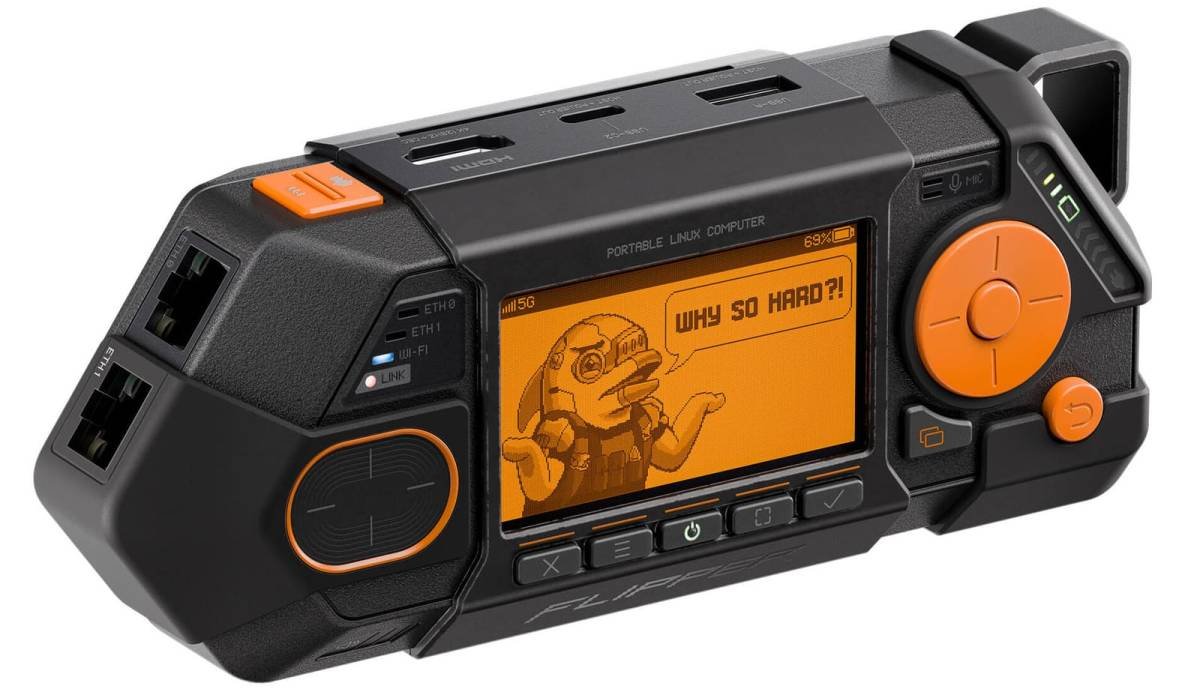
Flipper Devices, a well-known manufacturer of hacking devices, recently unveiled a new product called Flipper One. This innovative gadget boasts multiple network connectivity features and the ability to function as a Linux PC. Despite the success of their previous device, the Flipper Zero, which has sold over a million units and generated over $150 million in sales, the Flipper One operates on a different level and is not a direct successor.
The Flipper Zero has gained popularity within the hacking community for its ability to connect to various radios such as Bluetooth, RFID, NFC, sub-1GHz transceiver, and Infrared. This versatile device can be used for a range of purposes, from acting as a key fob or entry pass to more advanced tasks like spamming nearby iPhones.
In contrast, the new Flipper One device focuses on network connectivity through features like 2x Gigabit Ethernet, USB Ethernet (5 Gbps), and Wi-Fi 6E (2.4/5/6 GHz). Additionally, it comes equipped with an M.2 port that allows for the connection of various peripherals, including 5G modems, SDR modules, AI accelerators, SSDs, and Wi-Fi cards. This device is still in the development stage, with the company teasing its capabilities and potential.
Under the hood, the Flipper One will house two processors and 8GB of RAM. The primary processor is an eight-core RK3576 chip that runs on open Linux, featuring a Mali-G52 GPU and an NPU for local AI processing. The secondary chip is a two-core Raspberry Pi RP2350 microcontroller responsible for managing the device’s display, buttons, touchpad, LEDs, and power subsystem.
Flipper Devices is also working on developing its own Linux-based operating system, known as Flipper OS. This OS aims to provide users with a seamless experience by allowing them to access different profiles with pre-configured packages and settings, facilitating experimentation with software without the need to reflash SD cards.
Furthermore, the company is developing a FlipCTL interface to control small LCD screens on devices like the Flipper One, offering users a convenient way to interact with the device.
The Flipper One’s network connectivity drivers enable various use cases, such as using the device as a router, VPN gateway, or bridge. Users can transform it into a Linux desktop by connecting a monitor, keyboard, and mouse via a USB hub, or utilize it as a media box with support for 4K streaming at 120Hz through its HDMI 2.1 port.
While the Flipper One shows promise, there are still software components that need to be developed to unlock its full potential. The company is inviting developers to join the community and contribute to the software development process, with details about the consumer launch and pricing expected to be announced in the future.