
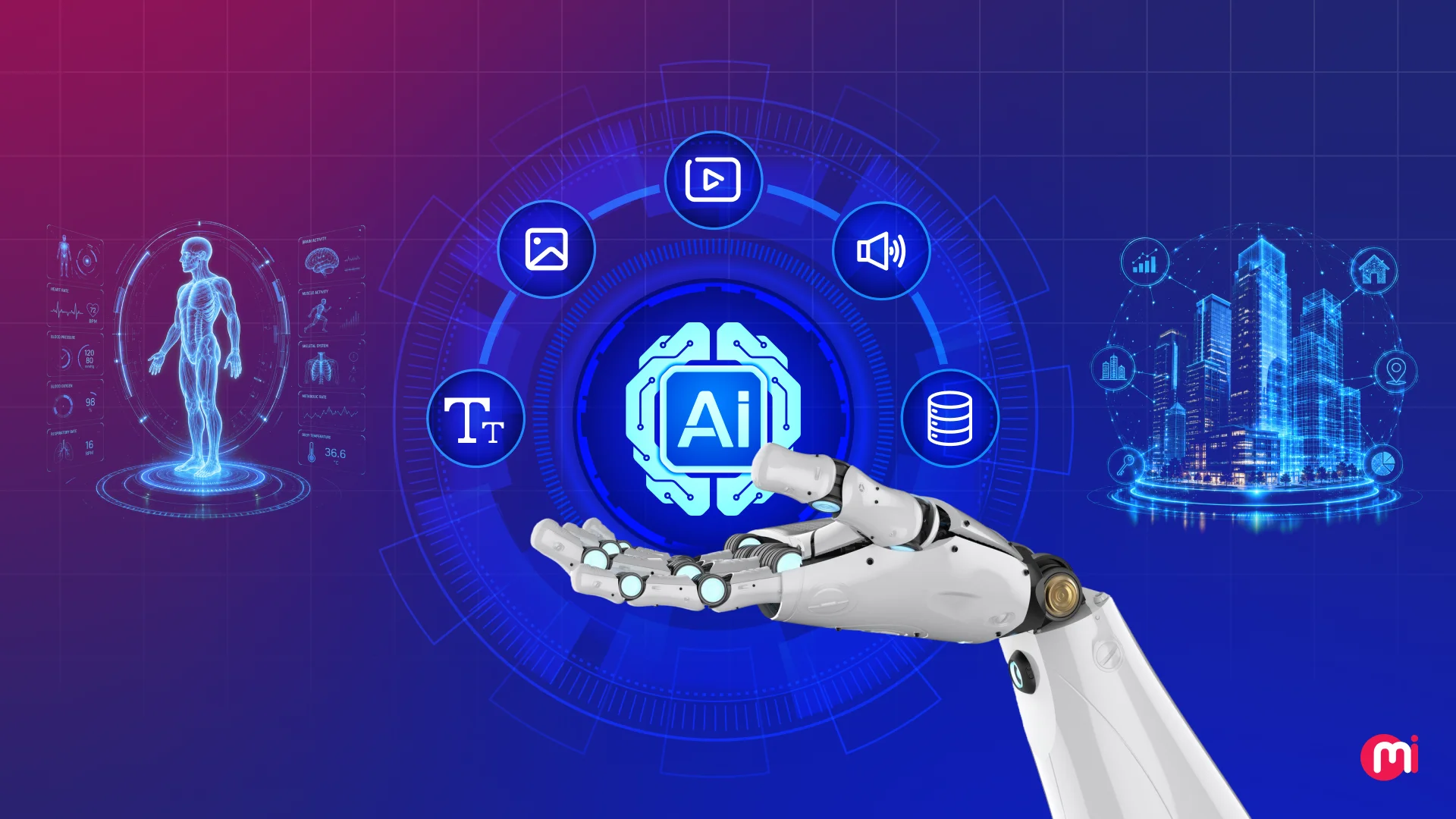
The landscape of artificial intelligence (AI) and machine learning (ML) is rapidly evolving, with multimodal AI emerging as a game-changer in how machines interact with and understand the world. Unlike traditional AI models that focus on a single modality, multimodal AI combines various data types like text, images, audio, and video into a unified system. This approach enables richer context processing, leading to more accurate insights and natural interactions.
Industries across the board are leveraging multimodal AI to power real-world applications. Companies such as Amazon, Tesla, and Google are using this technology to enhance user experience, improve decision-making, and drive innovation at scale. From visual search in e-commerce to autonomous driving and intelligent virtual assistants, the applications of multimodal AI are vast and impactful.
Multimodal AI works by encoding different types of inputs into a shared representation space, allowing the model to reason across modalities. This process involves specialized encoders for each modality, fusion strategies to combine inputs, and transformer-based architectures for reasoning and output generation. The result is a model that can process text, images, audio, and video simultaneously, mimicking human perception and handling complex real-world tasks.
Key applications of multimodal AI span various industries, including healthcare, education, retail, content creation, automotive, customer service, manufacturing, security, finance, and more. For example, in healthcare, multimodal AI is used for medical imaging to diagnose diseases more efficiently. In education, AI tutors provide multimodal learning experiences for students. In retail, visual search tools enhance the shopping experience. In content creation, AI accelerates production processes. In automotive, self-driving vehicles rely on multimodal AI for real-time decision-making. These examples showcase how multimodal AI is transforming industries and shaping the future of intelligent systems.
Popular examples of multimodal AI models include Google Gemini 1.5 Pro, GPT-4o, Claude 3, Sora, Whisper, Adobe Firefly, and more. These models demonstrate the capabilities of multimodal AI across different domains and use cases. Real-life examples, such as Google DeepMind’s collaboration with the NHS for eye disease detection and Walmart’s use of multimodal AI for shelf intelligence and inventory management, highlight the tangible benefits of this technology in action.
While multimodal AI offers significant advantages, it also presents challenges such as data alignment, computational intensity, data fusion, ethical issues, and evaluation difficulty. However, solutions like contrastive learning techniques, model compression, cross-attention transformer architectures, and diverse datasets can address these challenges and ensure the successful implementation of multimodal AI.
In conclusion, multimodal AI is reshaping how businesses operate by enabling them to automate complex tasks, improve user experience, and drive innovation. The future of multimodal AI holds promises of real-time agents, personalized AI companions, and deeper integration across digital touchpoints. By embracing this technology and overcoming challenges, businesses can gain a competitive edge and deliver transformative solutions to their customers.