
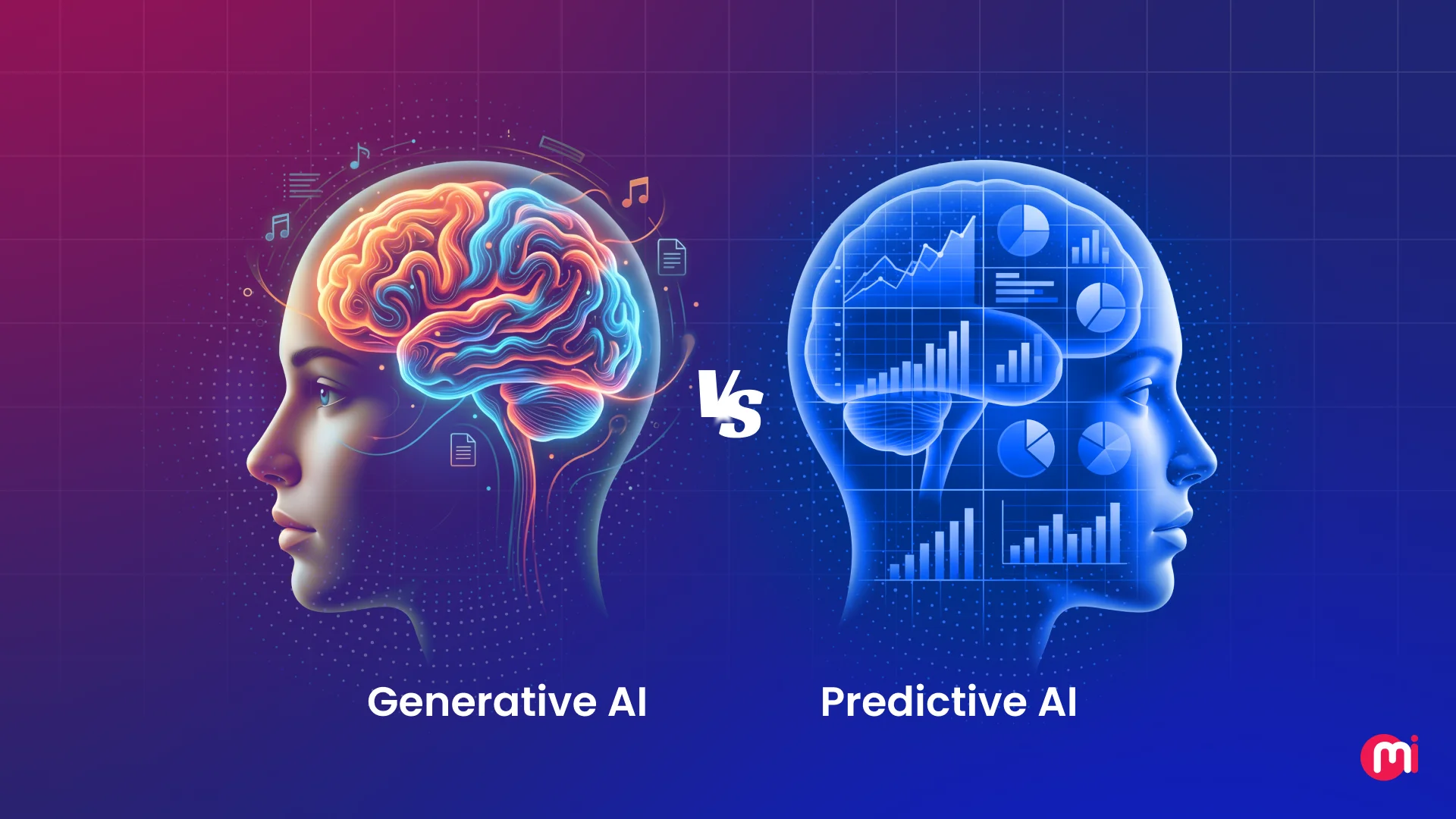
AI and ML – A Comprehensive Comparison
In today’s world, many advanced AI tools give the impression of predicting future outcomes. From conversational systems like ChatGPT to image generators like Midjourney and developer tools like GitHub Copilot, these tools seem to know what comes next. However, it’s essential to understand that they are not predictive AI tools, as they might initially appear.
When comparing generative AI versus predictive AI, it becomes clear that they serve different purposes and are fundamentally distinct from each other.
Generative AI, also known as gen AI, is a branch of artificial intelligence that focuses on creating original content such as text, images, videos, and software code. It achieves this by learning patterns from a vast amount of existing data. Unlike traditional AI, which analyzes and predicts, generative AI generates new outputs that mimic human creativity.
On the other hand, predictive AI uses historical data, statistical analysis, and machine learning to identify patterns and forecast future events, behaviors, or trends. While generative AI creates new content, predictive AI enables organizations to act proactively by anticipating risks, optimizing operations, and personalizing experiences.
The key differences between generative AI and predictive AI lie in their objectives, training approaches, data usage, model complexity, algorithms and architectures, output types, evaluation metrics, interpretability, computational cost, real-time versus creative use, human involvement, personalization capacity, and feedback loop.
Generative AI is best suited for tasks that involve creating content at scale, building conversational interfaces, demanding personalization at volume, augmenting human creativity, working with unstructured data, and generating synthetic data. On the other hand, predictive AI is ideal for scenarios that require data-driven decisions in real time, have a clear, measurable outcome, involve structured, historical data, prioritize accuracy and explainability, focus on optimizing operations, and have limited compute resources.
While both generative and predictive AI have their strengths and limitations, the most effective AI systems today combine elements of both to achieve optimal results. By leveraging the strengths of generative creativity and predictive precision, organizations can build AI systems that not only respond to the world but also shape it.
In conclusion, understanding the differences between generative AI and predictive AI is crucial for businesses looking to leverage AI technologies effectively. By choosing the right type of AI for the specific needs of a project, organizations can harness the full potential of artificial intelligence to drive innovation and growth.