
The Future of Data Centers in Space
Despite the excitement surrounding data centers in space, the presence of GPUs up there is still quite limited. However, this is slowly changing, and the concept of orbital compute is beginning to take shape in the near future.
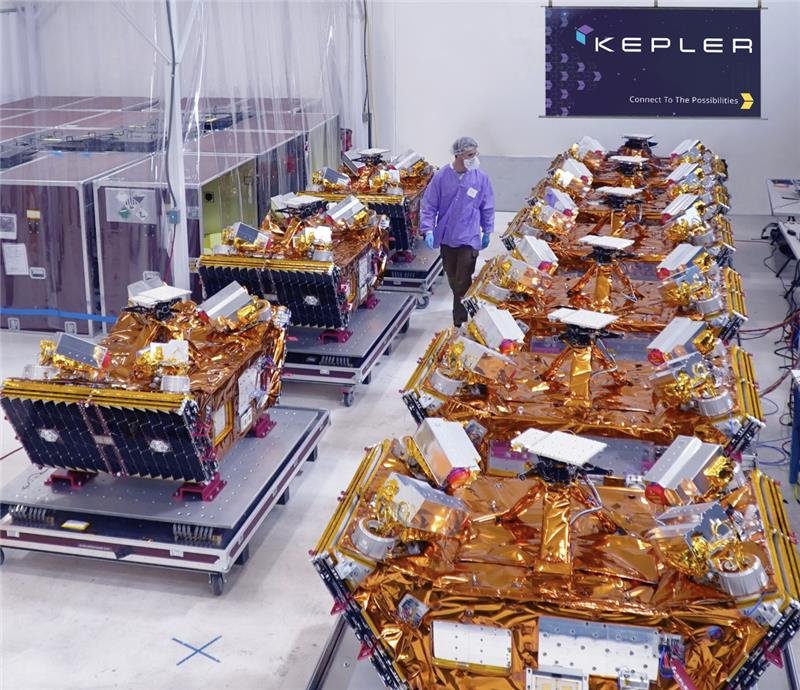
One of the most significant developments in this space is the launch of the largest compute cluster in orbit by Canada’s Kepler Communications. This cluster, launched in January, features around 40 Nvidia Orin edge processors spread across 10 operational satellites. These satellites are interconnected through laser communication links.
A Growing Market
With 18 customers on board, Kepler Communications recently announced a new partnership with Sophia Space, a startup focused on testing software for its unique orbital computer. This collaboration marks a significant step forward in the evolution of orbital computing.
Experts predict that large-scale data centers in space, as envisioned by companies like SpaceX and Blue Origin, may not become a reality until the 2030s. In the meantime, the focus will be on processing data collected in orbit to enhance the capabilities of space-based sensors used by private firms and government agencies.
Kepler’s Vision
According to Kepler CEO Mina Mitry, the company sees itself not as a data center provider but as an infrastructure facilitator for space applications. Kepler aims to offer network services for other satellites in space, as well as drones and aircraft in the sky below.
On the other hand, Sophia is working on developing passively-cooled space computers to address the challenge of keeping powerful processors from overheating in large-scale data centers in orbit without the need for heavy and costly cooling systems.
Testing New Frontiers
As part of their partnership, Sophia will upload its proprietary operating system to one of Kepler’s satellites and attempt to launch and configure it across six GPUs on two spacecraft. This groundbreaking experiment in orbit will help Sophia de-risk its operations before its first satellite launch planned for late 2027.
Techcrunch event
San Francisco, CA
|
October 13-15, 2026
Orbital Networking Services
For Kepler, the partnership with Sophia underscores the value of its network. As the sector evolves, Kepler anticipates collaborating with third-party satellites to provide networking and processing services. Mitry notes that satellite companies are already planning future assets based on this model, particularly for offloading processing for power-hungry sensors like synthetic aperture radar.
Edge processing, which involves handling data where it is collected for quicker responses, will be a key advantage of orbital data centers initially. This approach differentiates Sophia and Kepler from other space companies and startups focusing on large-scale data centers with data center-style processors.
The Power of Distributed GPUs
According to Mitry, the focus is on inference rather than training, with distributed GPUs being more beneficial than a single powerful GPU. The goal is to ensure that GPUs run at full capacity to maximize efficiency.
As these technologies prove successful in orbit, the possibilities are endless. Sophia CEO Rob DeMillo highlights the shifting landscape on Earth, with some regions imposing restrictions on data center construction. This trend could make space-based alternatives increasingly appealing.
With the future of data centers in space looking promising, the realm of technology is set for some intriguing developments. As DeMillo aptly puts it, “There’s no more data centers in this country. It’s gonna get weird from here.”