
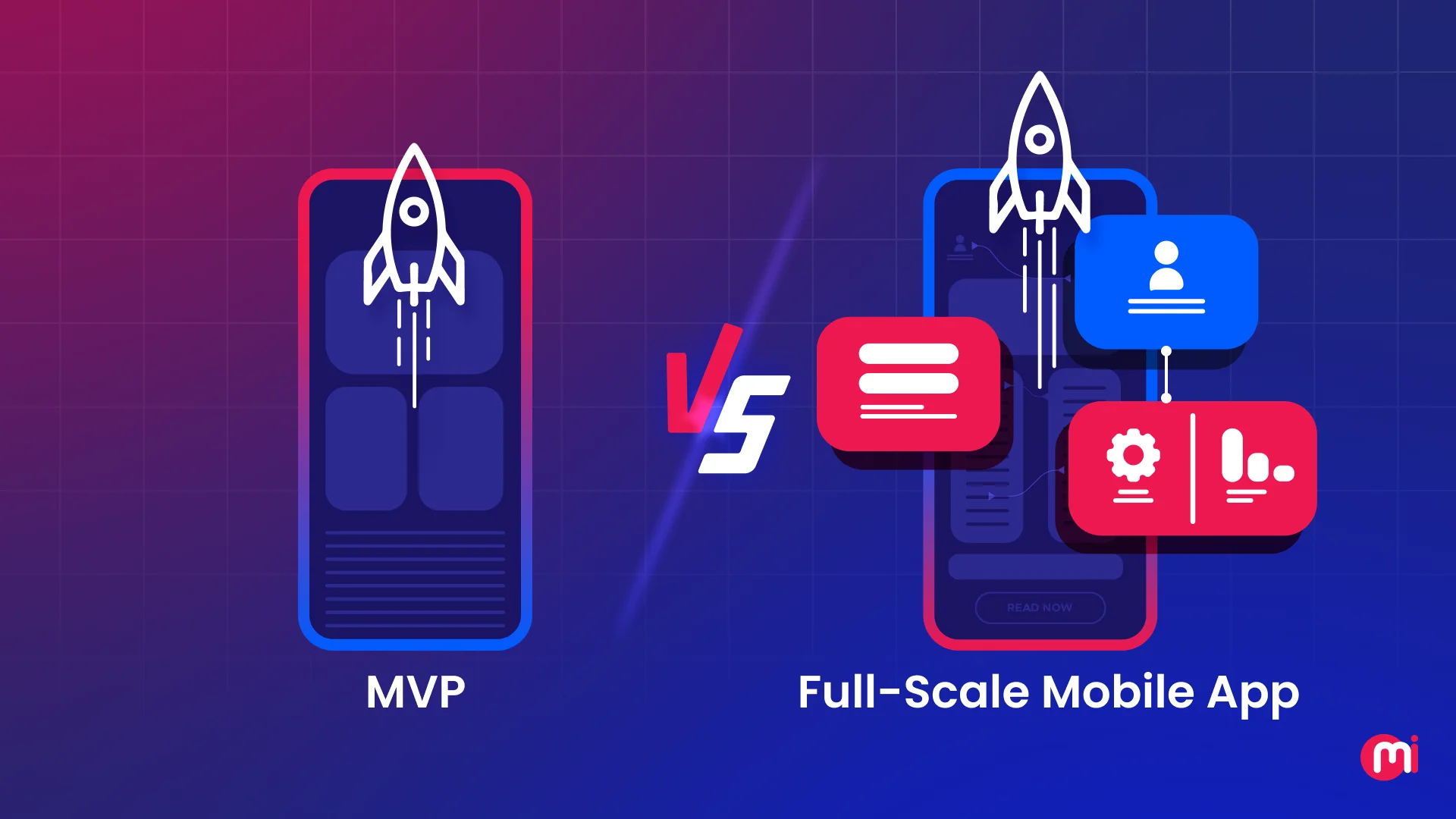
In the realm of startup development, approximately 35% of new ventures fail due to a lack of market demand, a trend that also affects mobile app creation. However, the concept of Minimum Viable Product (MVP) development serves as a crucial tool in mitigating this risk by validating assumptions early on and setting the stage for success upon product launch.
The urge to move swiftly, attract users, and impress investors can sometimes lead startups to overinvest in building before confirming the viability of their idea. Conversely, releasing a basic product with no clear roadmap can hinder growth. Therefore, the decision between MVP and full-scale app development hinges on factors such as business objectives, market certainty, budget constraints, and risk tolerance.
This article delves into the distinctions between MVP and full-scale mobile apps, highlighting their respective advantages and limitations to help entrepreneurs determine the most suitable approach for their startup. Whether MVP development services are needed or a direct plunge into mobile app development is advisable, this guide aims to provide clarity on the decision-making process.
Key Takeaways:
– An MVP emphasizes validating an idea with minimal features and a rapid launch time, while a full-scale mobile app encompasses comprehensive functionality and scalability from inception.
– Many successful companies like Instagram, Airbnb, and Uber originated as MVPs and evolved into full-scale platforms.
– Early-stage startups often benefit from building an MVP initially, while full-scale development is preferable when user needs are clear and market demand is established.
– The cost of an MVP for a mobile app typically ranges from $20,000 to $80,000, whereas full-scale mobile app development costs between $40,000 to over $400,000.
– Choosing between MVP and full-scale mobile app development hinges on factors like budget, user needs certainty, feedback speed requirements, and more.
What Is a Minimum Viable Product (MVP)?
A Minimum Viable Product (MVP) represents the most basic version of a new product containing only essential features to address specific user problems. The primary goal of an MVP is validation, not perfection. Instead of spending months or years on complete product development, MVP development enables businesses to launch mobile apps early, gather feedback, and enhance them based on real user interactions.
Benefits of an MVP for mobile app development include swift app release for maximum validated feedback from early adopters, testing the core idea with minimal effort and cost before committing to full-scale development, and quick iteration based on real-world data.
Key Characteristics of an MVP:
– Focuses on addressing one primary problem
– Includes limited but functional features
– Has a faster development cycle
– Requires lower initial investment
– Designed for testing assumptions
An MVP allows businesses to answer crucial questions early on, such as determining if users genuinely need the solution, their willingness to use or pay for it, and which features are most critical to them.
What Is a Full-Scale Mobile Application?
A full-scale mobile application is a comprehensive app designed with an extensive feature set, advanced user experience, integrations, and scalability considerations from the outset. Unlike MVPs, full-scale apps aim to deliver a refined experience ready for large-scale adoption. They are typically developed when businesses have a clear understanding of user needs and product requirements.
Key Characteristics of a Full-Scale App:
– Encompasses extensive features and functionalities
– Includes advanced UI/UX design
– Incorporates backend scalability
– Integrates third-party services
– Focuses on performance optimization
– Emphasizes security and compliance readiness
Examples of MVPs that Scaled to Full-Scale Applications:
Many well-known, multi-billion-dollar companies originated as MVPs designed to test core concepts. Examples like Instagram, Airbnb, Uber, and Dropbox began with minimal features to validate market demand before evolving into complex, full-scale platforms.
Instagram:
Initially named “Burbn,” Instagram started as a niche photo-sharing app focused solely on photo filters and sharing. It lacked features like video, direct messages, or stories. After succeeding with limited functionalities, the app scaled rapidly based on user feedback.
Airbnb:
The MVP for Airbnb was a basic website showcasing photos of the founders’ apartment rented during a conference to assess if people would pay to stay in a stranger’s home. As the concept gained validation, Airbnb expanded into a feature-rich, cross-platform app.
Uber:
Originally known as “UberCab,” Uber’s MVP operated exclusively in San Francisco, allowing users to request black car services via the app to validate the on-demand transportation model. Following successful validation, the app underwent complete development, establishing its global success.
Spotify:
Spotify launched as a desktop-only streaming app with limited music offerings, confirming the demand for fast, free music streaming before expanding globally. After validating the concept, Spotify evolved into a mobile app, catering to users worldwide.
Comparing MVP Vs Full-Scale Mobile Applications:
MVP and full-scale mobile app development vary across multiple parameters, including development time, cost, risk level, time-to-market, user feedback cycle, flexibility, and more. The table below outlines the key differences between these two approaches:
| Comparison Criteria | MVP Development | Full-Scale Mobile App Development |
|—————————-|————————————————-|————————————————-|
| Development Time | Typically takes a few weeks to a few months | May take several months or longer |
| Cost Investment | Lower upfront investment | Higher initial costs for design, development |
| Risk Level | Reduces risk by validating ideas early | Higher risk due to developing without validation |
| Time-to-Market | Faster market entry and early traction | Longer time to launch, but offers a complete experience |
| User Feedback Cycle | Encourages early feedback and continuous improvement | Often relies on assumptions made during planning stages |
| Flexibility for Changes | Easier to modify or pivot based on user insights | Harder and more expensive to change after development |
| Long-Term Scalability | Require architectural upgrades as the product scales | Designed for long-term growth from the beginning |
1. Development Time:
MVP development focuses solely on core functionality to address specific user problems. By excluding unnecessary features, complex integrations, and advanced design elements, MVP development timelines are significantly shorter. In contrast, full-scale app development entails detailed planning, feature development, testing, optimization, and scalability considerations, prolonging development timelines.
2. Development Cost:
MVP development necessitates lower initial investment since only essential features are developed. This approach enables startups to validate ideas without committing significant capital upfront, enhancing the likelihood of maximizing benefits. Full-scale mobile app development involves higher costs due to comprehensive feature sets, backend infrastructure, third-party integrations, security measures, advanced UI/UX design, and extensive testing requirements.
3. Risk Level:
An MVP substantially reduces business risk by enabling startups to test assumptions early on. Rather than relying solely on internal ideas or market forecasts, MVP allows startups to gather real user feedback before making substantial investments. In case adjustments or pivots are required, businesses can make changes with minimal losses. Full-scale mobile app development carries a higher risk due to substantial time and resources invested before real market validation occurs. If user expectations deviate from assumptions, rectifying course later on is likely to be costly and time-consuming.
4. Time-to-Market:
MVPs enable companies to launch swiftly, attract early adopters, and establish a market presence sooner. Early entry also facilitates data collection and rapid iteration compared to competitors. Conversely, building full-scale mobile apps typically requires more time to market due to their complexity. However, they may offer a refined user experience at launch, crucial in industries where initial impressions and feature completeness are paramount.
5. User Feedback Cycle:
Launching early enables startups to observe user interactions, identify pain points, and prioritize enhancements based on real usage data. This fosters a feedback-driven development cycle where the product evolves alongside user needs. In full-scale development, feedback often arrives later in the process, after significant development has occurred. While user feedback remains essential, effecting major changes at this stage can be challenging and expensive.
6. Flexibility for Changes:
MVPs are designed for experimentation, offering greater flexibility. Features can be added, removed, or modified swiftly as startups gain insights into user behavior and market demands. This adaptability proves invaluable in early-stage startups where product direction may evolve. Full-scale apps, on the other hand, adhere to predefined requirements and structured architectures. While modifications are possible, they often entail redesigning workflows, updating integrations, or adjusting infrastructure, increasing both time and cost.
7. Long-Term Scalability:
MVPs prioritize speed and validation over scalability. Consequently, as the product expands and gains traction, startups may need to upgrade architecture, enhance performance, or rebuild components to support growth. This progression is a standard part of the MVP-to-scale journey. Full-scale mobile applications are typically designed with scalability in mind from the outset. Architecture, databases, and infrastructure are planned to accommodate large user bases, increased traffic, and long-term expansion, reducing the need for significant restructuring later on.
When MVP Development Is Right:
An MVP (Minimum Viable Product) is appropriate when there is a need to validate core assumptions for an application, minimize development risks, and learn from real user feedback with minimal investment. It is ideal for testing new, unproven concepts, establishing product-market fit, or when market demand is uncertain, facilitating rapid iterations based on data.
Key scenarios where an MVP is the right strategy:
– Validating Hypotheses: MVP is suitable for confirming if customers indeed face the problem being addressed, rather than building a full product based on assumptions.
– Limited Resources/Time: Opt for MVP when a quick launch is necessary to save on development costs and avoid unnecessary feature development.
– High Market Uncertainty: MVP development is appropriate for launching a disruptive or new product where user behavior is unpredictable.
– Focus on Core Value: Choose MVP when identifying the most critical feature that renders the product useful.
Risks of Skipping the MVP Stage:
Many startups falter not due to technological shortcomings but because they invest excessively early on. Hence, the need for an MVP is paramount. Risks of bypassing the MVP stage include building unnecessary features, incurring high development costs before validation, delaying launch and missing market opportunities, struggling to pivot when assumptions prove erroneous, and depleting startup capital swiftly.
When Full-Scale App Development Is Right:
Full-scale mobile app development is suitable when there is a validated, high-demand, feature-rich product idea, typically for established brands aiming to maintain market leadership, security, and a seamless user experience. It is ideal for projects with substantial budgets and long-term scalability requirements.
Key scenarios where full-scale mobile app development is right:
– Established Market Position: Opt for full-scale development when a brand possesses a loyal customer base and necessitates launching a polished, high-performing app, such as a large-scale e-commerce platform or fintech solution.
– Complex Functionality: Choose full-scale development when the app demands sophisticated features, robust security, and seamless multi-platform integration that an MVP cannot provide.
– High-Stakes Competition: In scenarios where a feature-rich, high-performance mobile app is imperative to meet elevated user expectations immediately.
– Validated Business Model: When the concept has undergone thorough testing and the likelihood of failure is reduced, immediate investment in full-scale development is justified.
Transitioning from MVP to Full-Scale App:
An MVP marks the beginning, not the culmination of the product development journey. After achieving validation for the app, startups can transition to a full-scale application by:
– Analyzing user feedback and usage data
– Prioritizing high-impact features
– Ensuring user-centric design for UI/UX based on authentic behavior
– Strengthening backend architecture
– Gradually scaling infrastructure
This phased approach to full-scale development ensures every investment is supported by genuine user insights, leading to enhanced profitability. Hiring Android or iOS developers based on app type can provide expertise to build a high-performance application.
The Cost of MVP Vs. Full-Scale Mobile App Development:
There is a notable cost differential between MVP and mobile app development. An MVP for a mobile app typically incurs costs ranging from $20,000 to $80,000 and requires 2–6 months for development. Conversely, a full-scale mobile app often costs between $40,000 to over $400,000 and takes 6–18 months to develop.
Developing an MVP proves to be 60-70% more cost-effective, mitigates financial risks, and enables faster market validation. Opting for an MVP over full-scale development stands as one of the most effective methods to reduce mobile app development costs.
MVP Vs. Full-Scale App: How to Decide What Your Startup Should Build First:
Deciding between MVP and full-scale mobile app development becomes simpler when armed with clarity and the right set of questions to ponder. While every business grapples with its unique challenges and needs, addressing the following questions can streamline the decision-making process.
Ask yourself these questions and strive to answer them:
1. What problem are we validating?
– If uncertainty surrounds the core problem, initiating with an MVP is advisable.
2. How certain are we about user needs?
– If decisions hinge on assumptions rather than data, validation should precede full-scale development.
3. What is our budget and runway?
– Limited funding signals the need for MVP development to minimize risk.
4. How quickly do we need market feedback?
– Speed is critical, opt for an MVP to expedite learning and iteration. However, if time permits, full-scale development enhances outcomes.
Building MVP or Going Full-Scale with MindInventory:
Selecting between an MVP and a full-scale mobile app is not about choosing less versus more; it’s about selecting the appropriate strategy at the right juncture. For most startups, an MVP offers the swiftest and safest route to validation, learning, and growth. It enables founders to construct based on genuine user behavior rather than assumptions. Full-scale development emerges as the logical progression once product-market fit is attained and requirements are unequivocal.
Whether necessitating MVP development or comprehensive mobile app development services, MindInventory stands as the premier destination. As a leading mobile app development company, we deliver a holistic solution to transform unique ideas into apps. Consider how we crafted a mobile app for athlete healthcare & performance monitoring, benefiting the owner by managing 10K+ athletes post-launch, earning trust from 1K+ teams & sports clubs, and tracking 20+ performance metrics within the platform.
Whether Android app development, iOS development, or application modernization services to revamp legacy apps are required, we assist in hiring mobile app developers to fulfill diverse needs, from building new apps to upgrading and maintaining existing ones.
FAQs on MVP vs Full-Scale Mobile App:
What is the difference between an MVP and a full-scale mobile application?
– An MVP is a basic version of an app aimed at validating an idea with essential features, while a full-scale app incorporates complete functionality, advanced design, and scalability for large user bases.
Is an MVP always cheaper than a full-scale app?
– Yes, MVPs typically cost less initially due to their limited feature set and shorter development cycles.
How long does it take to build an MVP?
– Most MVPs can be developed within a few weeks to a few months. However, factors such as project requirements, developer expertise, and experience may influence the timeline.
Can an MVP become a full-scale application later?
– Yes, many successful apps, including Instagram and Airbnb, evolved from MVPs into full-scale applications through continuous improvements and scaling.
Should I build an MVP or go straight to full app development?
– For the majority of untested startup ideas, building an MVP is recommended. This approach reduces the risk of wasted time and budget on unwanted features. Full-scale development is ideal when the concept is already validated.