
Today’s post is the second in a series offering suggestions to educators trying to teach during our chaotic times.
Addressing the ‘Firehouse” of Political Developments
Shannon Carey teaches history in a public high school in Oakland, Calif.:
It is the very beginning of U.S. history class, with kids settling into their seats, pulling out their notebooks, and reluctantly putting away their phones. I cue up my slide deck and pull up my History Rhymes slide. An 11th grade girl sits straight up in her chair and says, “History Rhymes?! My favorite segment!”
I start by showing a news video of ICE protests in Minneapolis and then ask students to think about what we’ve learned as students of American history up to this point: What rhymes here? What continuity do you see? What changes can you identify?
The past two years, I have found it both morally necessary and instructionally useful to address the current fire hose of social and political developments. I teach in a very diverse public urban high school, and most students come into my U.S. history classroom hungry for information about what is going on around them, and, in many cases, what is happening to their communities.
As a history teacher, I am aware that it is easier for me than, say, a chemistry teacher to integrate the fast-moving political developments into my curriculum, so last year, at the beginning of the second Trump administration, during the rapid-fire string of executive orders and political earthquakes, I developed a way to integrate current events into (I hope) thoughtful analysis of historical continuity and change. As I have continued the practice this year, I now see it as not just a helpful way to make history relevant in the unusual time period we are living through but as a way for students to use their historical thinking skills in daily life.
I created History Rhymes warm-ups based on Mark Twain’s famous quote, “History doesn’t repeat itself, but it often rhymes.” To introduce the warm-up series, I asked students to analyze this idea and interpret what it meant. Then, on a semi-regular basis, I start the class by jumping into a pressing issue that is both relevant to students and their families’ lives and touches upon a historical theme we have addressed in class.
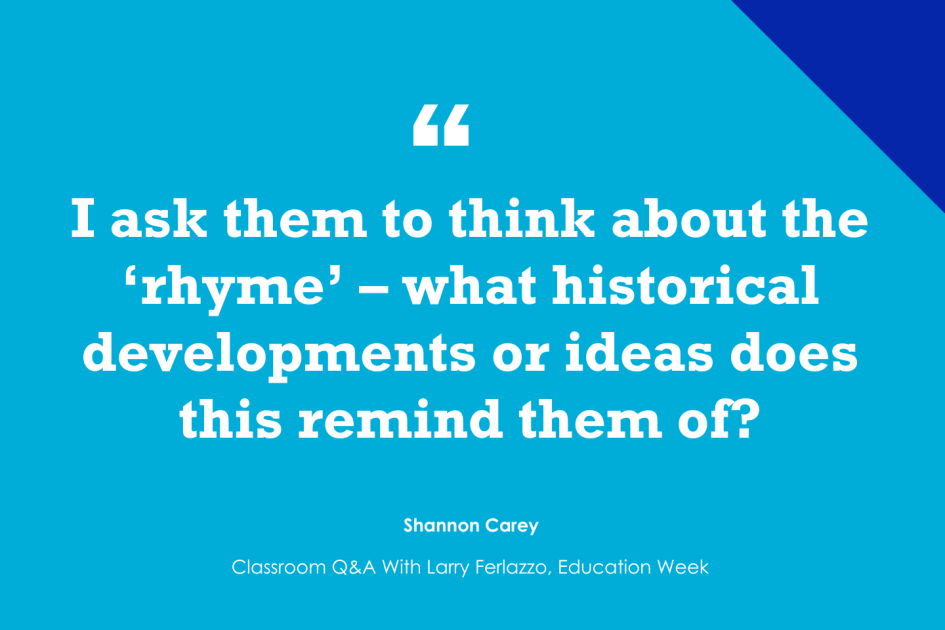
I will first ask students what they know about the issue and to discuss with one another what they have heard and where they have heard it. Then, I will find either a relevant video or primary source—the text, say, of an executive order or a photograph of an event—and ask students to think about what they understand to be happening. Finally, I ask them to think about the “rhyme”—what historical developments or ideas does this remind them of?
For the incident I describe in my first paragraph, the conversation was, as the youth (used to) say, “lit.” We had just finished studying the lead up to the Civil War when we looked at the surge of ICE abductions in Minneapolis and the shooting of Renee Good. Students immediately brought up the Fugitive Slave Act and the large-scale resistance to its increased enforcement .
One student brought up how constitutional due process guarantees seemed to be ignored in both eras. A student brought up how the Fugitive Slave Act would endanger the liberty of already escaped or free Black people, just as ICE was also targeting American citizens. Another student compared the Minneapolis observers, armed with whistles, watching for ICE to the Black Panther Party for Self Defense and its original mission of legally, openly carrying weapons and silently observing Oakland police when they would pull over Black motorists.
Sometimes, the topics I choose are inspired by salient news of the day that I cannot ignore —like the ICE siege on Minneapolis—and other times by the curriculum that I am teaching. When I introduced John Adams’ 1793 Alien and Sedition Acts this fall, for instance, President Donald Trump had recently reinvoked the act. This gave us the opportunity to both compare Adams’ reasons for passing the acts, targeting the French, and examine Trump’s claims about a Venezuelan “invasion.”
Similarly, when I introduced the 14th Amendment, I also shared with the students Trump’s January 2025 executive order revoking birthright citizenship. I asked students to consider the original purposes of the amendment, and, based on their close reading of the amendment, if they believe the order to be constitutional.
I have found this approach useful for two reasons. First, in an era when many students receive the message that studying the humanities is impractical and unimportant and should be subordinate to STEM programs, I am able to make the case that being historically literate is useful and important and allows us to better understand where we are today and how we arrived here.
Second, I have been able to dissuade students from seeing the admittedly wild events of this year as somehow outside the scope of American history and possibility. While some pundits have talked about this moment in American history—with rising authoritarianism and shrinking civil rights and civil liberties—to be “unprecedented,” History Rhymes reminds us that Americans have addressed abuse of power for a long, long while. I want students to recognize patterns of this abuse of power but also recognize patterns of concerted, organized resistance to this abuse and work toward a just, multiracial democracy.
While it is hard enough to teach our assigned curriculum given the material and time restraints we all face as teachers, diving into the constantly evolving history in the making we are living through can bring both relevance to your instruction and a way for students to see the value of a rigorous understanding of history as young people, as future voters, and as part of a United States they are co-creating.
The ‘RISE’ Protocol
Erinn Leone is a history-social science content specialist and a former Sacramento County, Calif., Teacher of the Year, sharing expertise in curriculum design and professional learning for educators:
Bringing current events into the classroom can feel daunting. Some wonder why teachers should focus on the news when there’s so much curriculum to cover. Yet, current events offer a powerful opportunity for students to practice critical thinking, historical reasoning, media literacy, and civic engagement in real time. Analyzing the present can help students recognize bias, understand multiple perspectives, and make connections between history and the world around them.
The RISE Protocol provides a framework for guiding these conversations thoughtfully and responsibly. You can download a handout about it here.
Regulate and Root:
To begin, teachers and students co-construct norms to ensure that every voice is respected and that all participants commit to curiosity, active listening, and reflection. Norms create a safe foundation; the entire protocol falls apart without them.
Next comes positionality and bias checks, where students reflect on how their identity, background, and prior knowledge shape their interpretation of information. Positionality and bias checks help students reflect on questions like, “How might aspects of my identity influence how I read or react to this source?” This self-awareness is crucial, not only for recognizing bias in the sources they analyze but also for understanding how one’s own perspectives, experiences, and identity shape the way they interpret the information in those sources.
Finally, this step includes preteaching background knowledge and vocabulary, giving all students the context and tools they need to participate. Whether through curated readings, mini-lessons, background cards, timelines, or visual aids, this preparation ensures students’ access is not limited by gaps in prior knowledge. Together, these three components prepare students to enter the discussion regulated and rooted in self-awareness, perspective, and foundational knowledge.
Investigate
Students move beyond surface-level reactions to analyze a current event through multiple lenses. This is where historical thinking and media literacy intersect: Students examine curated sources (including news articles, primary documents, and data) to understand not only what happened but why it happened and how it connects to broader historical patterns. Teachers might bring in primary sources that show political, social, or economic forces at play, helping students contextualize the event within its larger historical setting.
A guiding question that drives this work step is, “How do historical context, power, and perspective shape the way this event is reported and understood?.” This encourages students to trace patterns across time, to recognize recurring dynamics, and to see the ways in which past decisions, policies, and structures influence the present. By the end of this step, students have not just observed an event but placed it within a historical through line, gaining a deeper understanding of its origins, consequences, and connections.
Speak and Share
This step is a structured oral literacy routine, not a debate. Its goal is to give students structured time to explain their reasoning, listen for perspective, and reflect on how others interpret the same evidence. There are many ways to engage students in this practice.
One effective approach is the structured academic-controversy protocol, which guides students to explore multiple perspectives on a current event, understand the historical and social forces shaping those perspectives, and consider potential compromises or solutions. Other approaches might include Socratic seminars, fishbowl discussions, or partner share-outs. Regardless of the format, the focus is on helping students practice academic discourse. The aim is not to persuade or reach agreement but to build understanding, empathy, and critical thinking through dialogue.
Extend
This step encourages students to connect what they’ve learned to the world beyond the classroom. Extension activities can be small, reflective, or actionable. For example, students might:
- Draft thoughtful questions the public should ask when similar current events arise.
- Write a letter to a newsroom highlighting perspectives that were missing or asking for clarity about certain reporting choices.
- Reflect on how the event and its coverage might inform policies or practices in their community or school.
This shows students that engaging with current events is not passive. Students can practice critical thinking, civic responsibility, and historical reasoning in ways that matter, reinforcing that their analysis and voice have value beyond the classroom.
When students are taught how to engage with current events thoughtfully and critically, rather than simply absorbing what’s presented to them, they build durable skills. Educators have a unique opportunity to model and guide this learning, equipping students with the tools to analyze information, navigate disagreement, and understand power and bias.
These skills don’t just matter in the classroom; they matter for life. Students who practice historical thinking, media literacy, and structured civic dialogue are better prepared to participate in society as adults who can engage thoughtfully with current events, make informed decisions, and contribute responsibly to their communities.

Thanks to Shannon and Erinn for sharing their thoughts.
Consider contributing a question to be answered in a future post. You can send one to me at lferlazzo@epe.org. When you send it in, let me know if I can use your real name if it’s selected or if you’d prefer remaining anonymous and have a pseudonym in mind.
You can also contact me on X (formerly Twitter)at @Larryferlazzo or on Bluesky at @larryferlazzo.bsky.social.
Just a reminder; you can subscribe and receive updates from this blog via email. And if you missed any of the highlights from the first 13 years of this blog, you can see a categorized list here.