
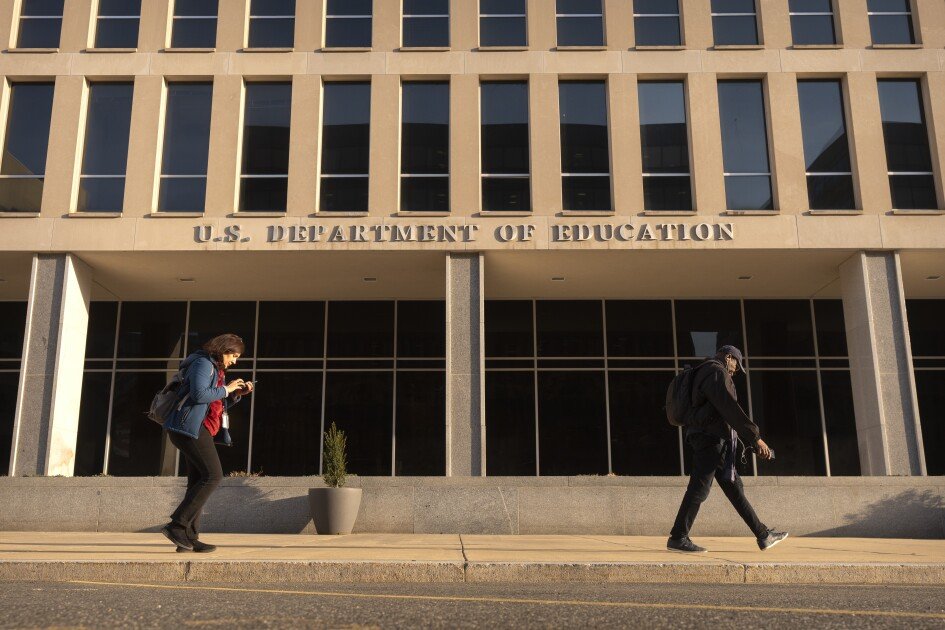
The U.S. Department of Education spent up to $38 million last year paying staffers from its office for civil rights to remain on administrative leave while the Trump administration’s efforts to lay them off were stymied by courts, according to a report from Congress’ investigative arm.
The Government Accountability Office reached its cost estimate—a range of $28 million to $38 million—by ballparking the salaries and benefits for the staffers, who were removed from their jobs last March as part of the Trump administration’s push to dismantle the Education Department.
In the civil rights office, that reduction in force—or RIF—affected 299 staffers, about half of OCR’s staff of 575 at the time, GAO said.
The office is charged with ensuring school districts and colleges comply with federal civil rights laws. Laid-off employees were initially placed on paid administrative leave before they were to be terminated in June.
OCR employees were prohibited from working while they were on leave, GAO noted. But as legal challenges to department layoffs proceeded, court orders ended up prolonging their administrative leave before the Education Department ultimately returned OCR staffers to their jobs in recent months.
To put that $28 million-$38 million range in context, the upper end is a little less than the amount the state of Vermont received for Title I grants to school districts last fiscal year.
And it’s more than the roughly $20 million budget last year for the department’s civics education competitive grant program. The Trump administration had sought to zero out the grants in its 2026 budget proposal, but lawmakers ultimately preserved the funding.
The GAO was unable to give an exact figure for the amount spent on paying laid-off staffers because the Education Department hasn’t complied with transparency requirements issued to all agencies by the Trump administration’s Office of Management and Budget, which oversees federal spending, and the Office of Personnel Management, which is responsible for the federal workforce.
Without that information, it’s difficult to say whether the staff reductions at OCR achieved the Trump administration’s stated goal of creating a more efficient, leaner workforce at OCR, GAO concluded.
“Education cannot ensure that OCR improved service to the American people, increased productivity, or reduced its overall budget,” for the federal fiscal years covered by the report by axing employees, the GAO said in its report.
Kimberly Richey, the assistant secretary who leads OCR, argued in response to GAO that the Education Department couldn’t provide more detailed information because some employees subject to the reduction in force returned to their jobs in December.
Ongoing litigation also prevented the department from participating in GAO’s investigation, Richey wrote.
The OCR layoffs have languished in legal limbo for months, since two court orders last spring required the Trump administration to return laid-off Education Department staff to their jobs. Though the U.S. Supreme Court issued a preliminary ruling last July that allowed the layoffs in other Education Department offices to proceed, OCR staffers were protected by the second court order that addressed only them.
The Education Department started bringing back OCR staff in September under that order, until a federal appeals court on Sept. 29, 2025, permitted the OCR staff reductions to go forward.
Days into the federal government shutdown in October, the Education Department issued RIF notices to additional OCR staffers who had been spared from the March reduction in force. When a judge ultimately halted those layoffs ordered during the shutdown, the Education Department also abandoned the OCR layoffs stemming from the March reductions.
It started reinstating those OCR staffers late last year, and has since rescinded all their layoffs, according to GAO.
Along with the staff reductions, the department also shuttered seven of OCR’s 12 regional offices, in Atlanta, Boston, Cleveland, Chicago, Dallas, Philadelphia, and San Francisco. OCR reassigned their caseloads to the five remaining offices.
OCR’s work slowed down in wake of staff reductions, observers say
OCR received more than 9,000 complaints of alleged discrimination between March 11 and September 23 of last year, GAO reported. It resolved more than 7,000 of those complaints—though it resolved about 90% of those complaints by dismissing them.
The dismissal rate is “a lot higher than what would be typical,” said Jackie Gharapour Wernz, a civil rights lawyer who works ith schools and served as a career employee in OCR from 2016 to 2018 under both Democratic and Republican administrations. “I would be fascinated to see the basis for the dismissals.”
OCR staff can choose to dismiss a complaint on a technicality or because it lacks “sufficient detail,” a term that can leave legal wiggle room.
In its second term, the Trump administration has also taken the unusual step of using OCR to drop a legal hammer on school districts, universities, and states going against Trump policy priorities by embracing diversity, equity, and inclusion initiatives and letting transgender girls compete on girls’ athletic teams.
For instance, last year, OCR told New York’s state education department that its policy prohibiting schools from adopting Native American mascots violates civil rights law.
Still, Wernz has noticed that the OCR has “significantly slowed down” after the RIFs, even in cases that center on the Trump administration’s favorite issues.
Case in point: Wernz expected a rash of investigations into schools and colleges after the assassination of right-wing activist Charlie Kirk in September prompted a wave of teacher suspensions and dismissals over their social media comments about the killing. But they didn’t materialize, she said.
“They’ve just neutered the institution,” said Wernz.
The public shouldn’t shift the blame for the wasted funds onto OCR staffers, Wernz said.
Employees she’s in touch with “did not enjoy sitting there and having their talents be wasted,” she said.
But they also determined, “‘if we don’t hang on, they’re going to decimate the organization even more.’”